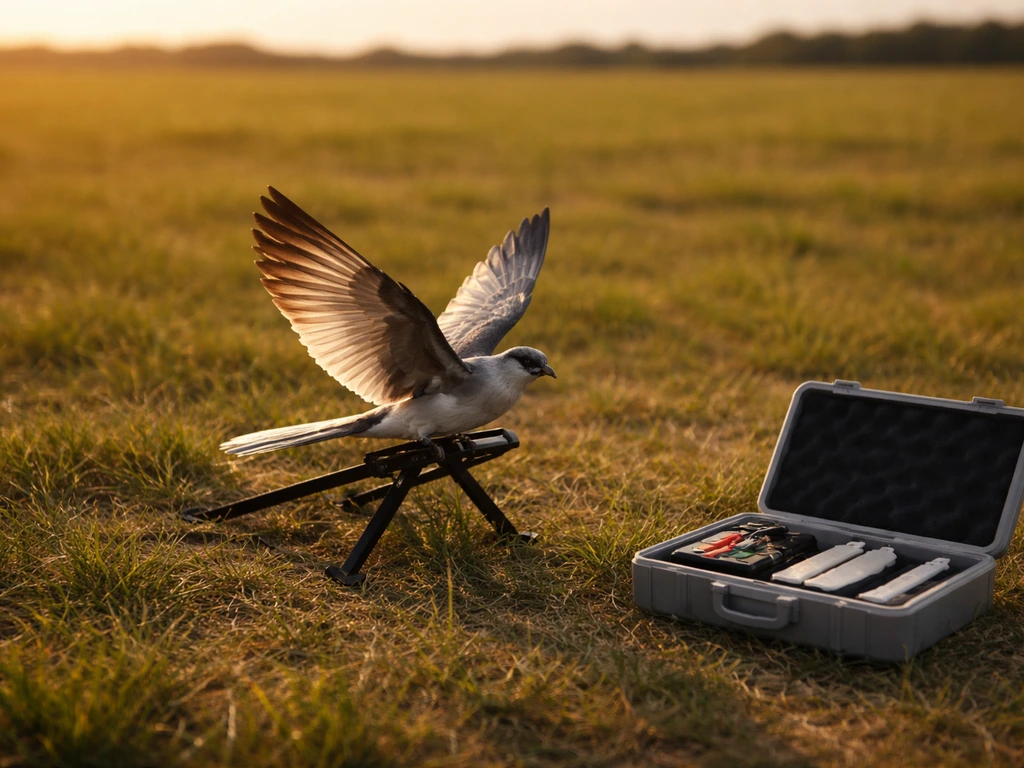
To get into bird banding, you need to find a licensed bander willing to train you, work under their supervision until you're genuinely competent, and then apply for your own permit. That's the core path, whether you're in the US, Canada, the UK, or most of Europe. You cannot legally band birds on your own without a permit, and permits are not handed out without demonstrated training. The good news: motivated beginners are genuinely welcome in most banding programs, and you can make real progress this season if you start reaching out today.
How to Get Into Bird Banding: Licenses, Training, and First Season
Marcus Hendricks
13 May 2026
What bird banding actually is and what you'll do
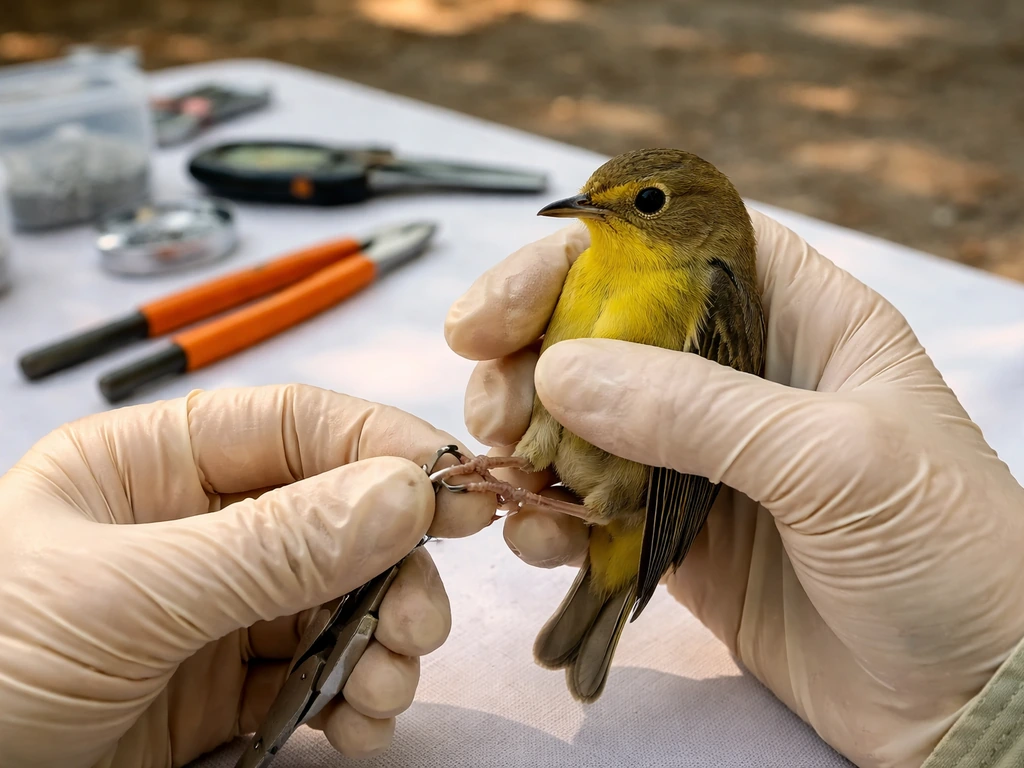
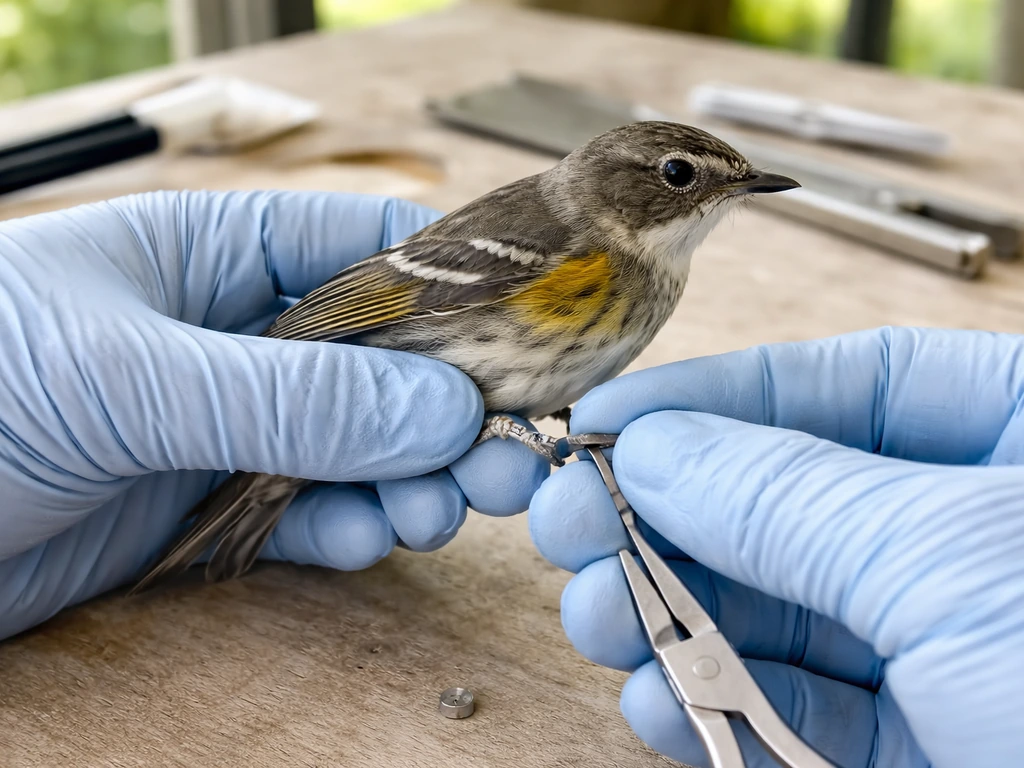
Bird banding (called bird ringing in the UK and much of Europe) is the practice of attaching a small, numbered metal or color band to a bird's leg so it can be individually identified if caught again or found later. That data, collected across thousands of stations and millions of birds, is how scientists track migration routes, survival rates, population trends, and the effects of habitat change. The US Geological Survey's Bird Banding Laboratory alone manages more than 72 million banding records. So when you band a bird, you're contributing to something much bigger than a single morning in the field.
On a practical level, here's what you'll actually be doing as a new bander: helping set up mist nets before dawn, walking net rounds every 30 minutes or so to remove birds safely, carrying birds in cotton bags back to a banding table, learning to age and sex birds by feather and physical characteristics, fitting the right size band, recording data, and releasing the bird. It sounds simple, but the devil is in the details. Handling a tiny warbler confidently without harming it takes real practice. That's why the training requirement exists.
Permits, licenses, and legal requirements
This is the part people want to skip, but don't. Banding migratory birds without a permit is illegal in most countries, because migratory birds are protected under national and international law. Here's how the permit system breaks down in the main regions: If you still need clarity on how to get a bird permit in your region, follow the steps for permits and training outlined next.
United States
The USGS Bird Banding Laboratory (BBL) issues federal banding permits. There are a few permit types: a master station permit (tied to a location), a master personal permit (tied to an individual), and sub-permits. As a beginner, you'll almost certainly start as a sub-permit holder under a master permittee. A sub-permit defines exactly what you're authorized to do, whether that's banding, recording data, acting as bander in charge, or working as a non-banding data manager.
The BBL will only approve a sub-permit authorization for a technique or species group once you are fully trained and able to operate independently. Some groups, like hummingbirds and eagles, have additional training and experience requirements on top of the standard ones. If you ever want to work with endangered species, you'll also need a Section 10 Recovery Permit from the US Fish and Wildlife Service before BBL can issue that specific authorization.
Canada
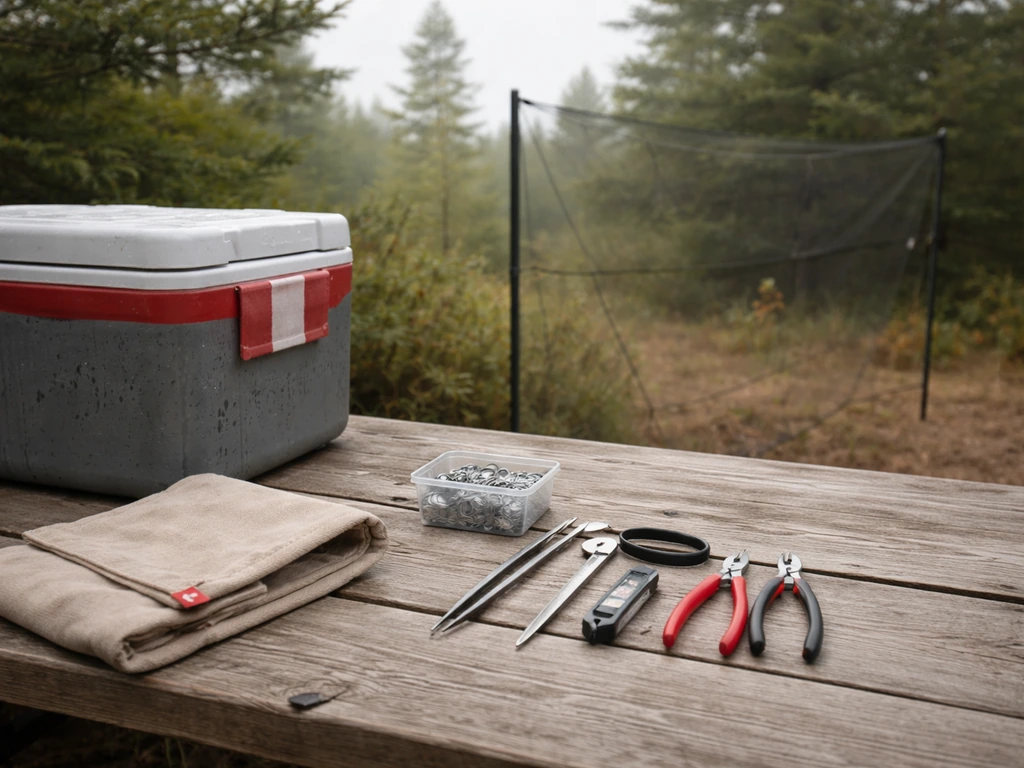
In Canada, the Canadian Bird Banding Office (part of Environment and Climate Change Canada) issues scientific permits under the Migratory Birds Convention Act. Your application has to justify why banding is the best method to achieve your research or monitoring goals. Like the US, the expectation is that you train under an experienced bander before applying for your own permit.
UK and Europe
In the UK, the British Trust for Ornithology (BTO) coordinates ringing, and the process involves getting a training permit and working under a licensed ringer. Licensing varies slightly by devolved region: in Wales, for example, you apply through BTO but the licence is issued by Natural Resources Wales. If you're under 18, there's a specific youth-trainee pathway that includes a successful taster season before formal training begins, plus a T-Permit application process. Across Europe, each country runs its own National Ringing Scheme coordinated under the EURING umbrella, so your first step is finding which national scheme covers your country.
One thing that applies everywhere: if you want to band on private land, you need the landowner's permission. That's separate from any government permit and is just basic courtesy and legal sense.
Finding a mentor and getting trained
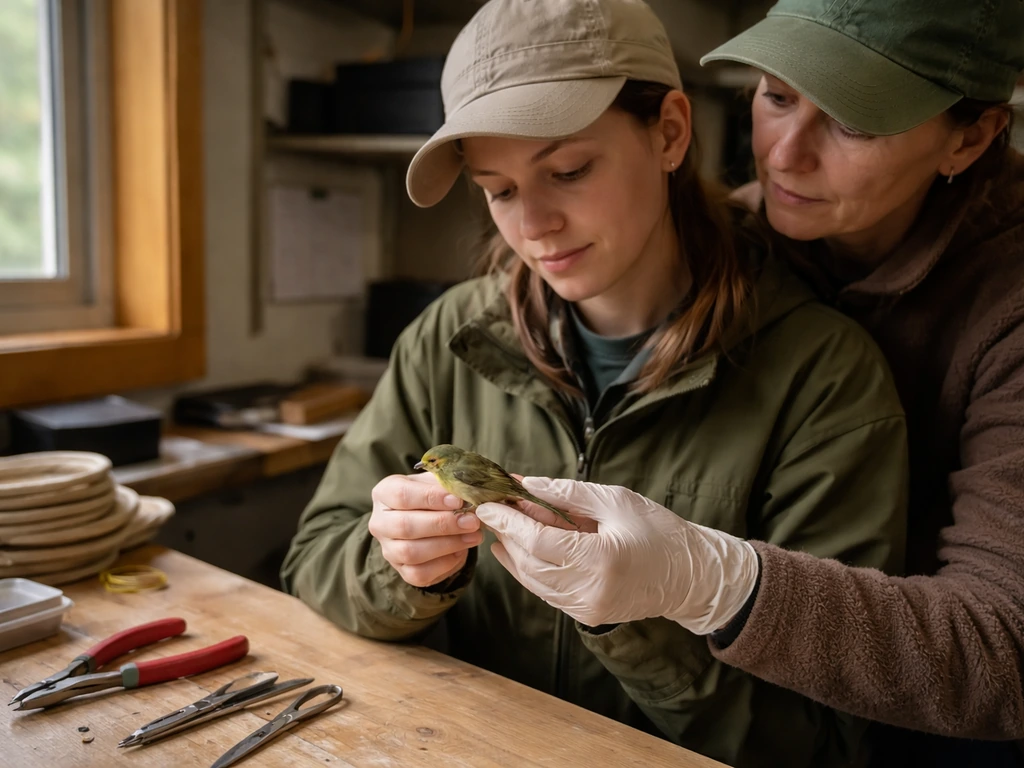
Finding a mentor is the single most important step. Everything else flows from it. A good mentor will train you on handling, teach you the species ID and aging/sexing skills you need, vouch for your competence when you apply for your own permit, and keep you from making the mistakes that injure birds or get people in trouble. Here's how to find one:
- Contact your regional bird observatory or banding station directly. Many run volunteer programs and actively need help on net rounds.
- Reach out to your local bird club or ornithological society. Ask if any members hold banding permits and whether they take on apprentices.
- In the US, check the BBL's list of permitted banders or look for MAPS (Monitoring Avian Productivity and Survivorship) stations near you, which are often run by PRBO Conservation Science affiliates and similar groups.
- In the UK, the BTO has a trainer-finder tool on their website specifically for connecting trainees with licensed ringers.
- Attend birding festivals and workshops. Banders often give demonstrations and those are great first conversations.
- University biology departments sometimes run banding programs and welcome committed volunteers.
Before you contact anyone, do a little homework. Know the basics of local bird species, practice the phonetic bird-in-hand alphabet for aging/sexing (Pyle's guide for North American birds is the standard reference), and read up on mist netting protocols. Showing up informed makes a much better impression than showing up empty-handed.
Workshops and short courses are another route in. The North American Banding Council (NABC) publishes training courses for various groups including landbirds, raptors, and waterfowl. The BTO runs training weekends in the UK. These don't replace hands-on apprenticeship but they accelerate your learning significantly and help you meet the community.
Equipment: what you need now vs. what to wait on
Don't buy a lot of gear before you've started training. Seriously. I've seen eager beginners spend money on mist nets before they've learned to set one up, and it's just wasted cash at that stage. Here's a practical breakdown:
| Item | Buy now? | Notes |
|---|---|---|
| Good field guide (local birds) | Yes | Essential before day one. Know your species. |
| Pyle's guide (Identification Guide to North American Birds) or regional equivalent | Yes | The bander's bible for aging and sexing. Get the volume relevant to your region. |
| Headlamp | Yes | You'll be setting nets in the dark. Get one with a red-light mode. |
| Waterproof notebook + pencils | Yes | Simple and reliable for field data entry. |
| Mist nets | Wait | Your mentor/station will have these. Don't buy until you have your own permit. |
| Bands and banding pliers | Wait | Bands are issued through official channels (BBL, ECCC, BTO). You can't just buy them. |
| Banding bags (cloth extraction bags) | Ask your mentor | Some stations provide these; they're cheap and useful to have your own set. |
| Digital calipers and scale | Maybe | Useful for taking wing chord, tarsus, and weight measurements. Ask your mentor first. |
| Data entry app (e.g., BandIt or station-specific app) | Wait | Learn the paper process first, then move to digital. |
One thing worth buying early: a quality loupe or magnifying glass. Aging birds by feather wear and molt limits often requires close examination of individual feathers, and you'll use a loupe constantly at the banding table.
What happens during a banding session
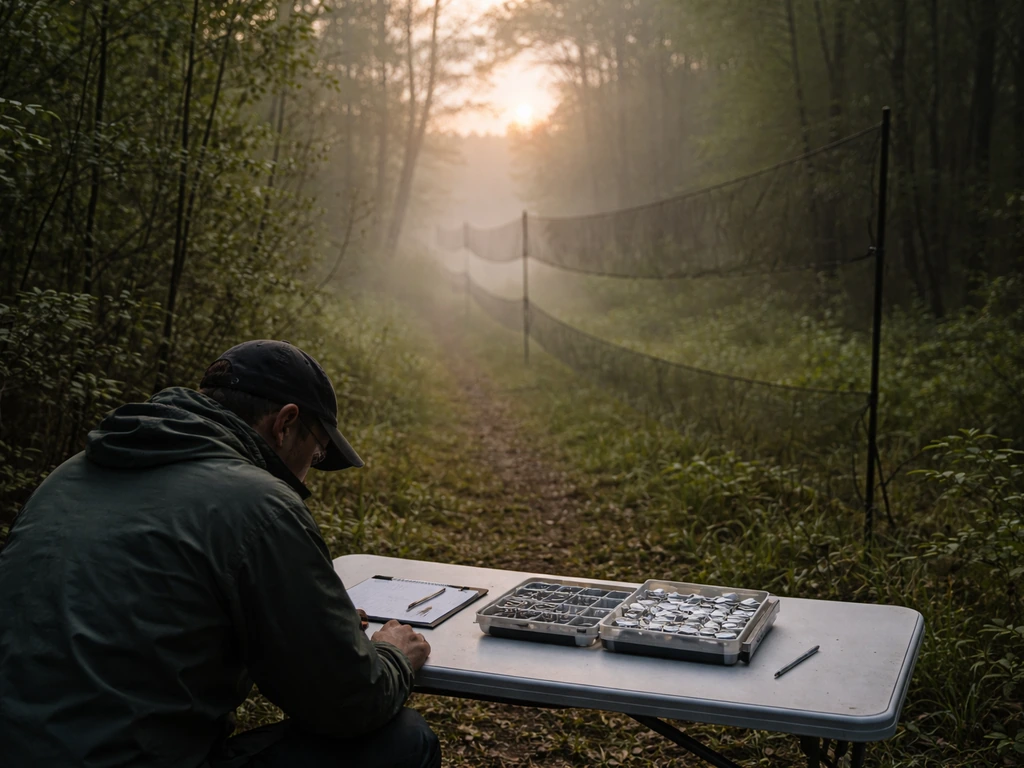
A typical passerine banding session runs from first light to mid-morning, usually about 4 to 6 hours. Here's the flow from start to finish:
- Arrive before dawn. Set up mist nets in positions that funnel birds along natural flight paths: woodland edges, shrub rows, near water. Nets are typically 6, 9, or 12 meters long and very fine so birds don't see them.
- Open nets at first light when bird activity peaks. Every net gets checked on a consistent rotation, usually every 20 to 30 minutes. Longer waits increase stress and injury risk.
- When you find a bird in the net, remove it using a specific extraction technique that varies depending on how it's tangled. This is a skill that takes practice. If you're not sure, call for help rather than forcing it.
- Place the bird in a cloth drawstring bag and carry it to the banding table. Bags keep birds calm and reduce flapping.
- At the table, the bander in charge takes the bird and works through a sequence: identify species, determine age and sex from plumage and physical characters, select the correct band size for that species, apply the band with banding pliers, and take standard measurements (wing chord, mass, sometimes tarsus or bill).
- Record all data on the data sheet or app: band number, species code, age, sex, measurements, date, time, location, net number, and disposition (new band, recapture, or recap from another station).
- Release the bird in the direction it was flying, close to where it was caught. Watch that it flies off normally.
- Close nets at the agreed time, usually mid-morning when activity drops. Nets must never be left unattended when open.
- At the end of the session, enter or review all data, pack equipment carefully, and submit data according to your program's schedule.
Bird safety, ethics, and handling with care
The whole point of banding is to generate data that helps birds, so welfare comes first, always. Here are the non-negotiables:
- Never leave nets open and unattended. Birds can die quickly in a net if left too long, especially in hot or cold weather.
- Check nets more frequently in hot weather or if capture rates are high. Stress and overheating are the main killers.
- Learn the 'bander's grip' (also called the photographer's grip) before you handle birds. It's a specific way of holding a bird between your fingers that keeps it secure without compressing the chest.
- If a bird is showing signs of severe stress (eyes closing, limpness, labored breathing), release it immediately without banding. Data is not worth a dead bird.
- Never band during extreme weather: high heat, freezing temperatures, or heavy rain. Reschedule instead.
- Handle birds quickly and efficiently. The less time on the table, the better. An experienced bander can process a common species in under two minutes.
- Wash hands between birds when possible to avoid transferring parasites or pathogens.
- Never photograph a bird in a way that extends the handling time beyond what processing requires. Keep phones and cameras away from the banding table unless you're documenting something specific.
- Follow all minimum age requirements for banding nestlings and know which species have seasonal restrictions.
Ethics also extend to the data you produce. Sloppy data is almost worse than no data, because it introduces errors into datasets that researchers rely on. If you're unsure about an age or sex call, record it as unknown rather than guessing.
Recordkeeping and submitting your data
Data submission is not optional, and it's not something you do whenever you feel like it. Your permit conditions will specify submission schedules, and the whole scientific value of banding depends on data actually getting into the central databases.
In the US, permittees use the BBL's Bander Portal to submit banding and recapture data, manage permit tasks, view submission history, and order and confirm bands. In a USGS Open-File Report on the Bird Banding Laboratory (BBL), it notes that BBL issues permits and bands to permittees, records bird band recoveries and encounters primarily through telephone or Internet reporting, and manages more than 72 million banding records and more than 4. 5 million encounter records [the BBL's Bander Portal](https://pubs. usgs.
gov/of/2013/1238/). You'll enter standardized data fields for every bird processed. If a banded bird is reported found (by the public, or by another bander), that encounter record goes into the system via reportband. gov, the USGS's public reporting tool.
Over 4. 5 million encounter records are in that system, and every one of them started with someone submitting a form correctly.
In the UK, data goes into DemOn (Demography Online), the BTO's online system for ringers and nest recorders. You enter records session by session, and the BTO uses that data for national monitoring and research publications. In Canada, data is submitted through the Canadian Bird Banding Office's reporting system.
Start building good data habits from day one. Fill in every field. Double-check band numbers character by character. Flag anything unusual in the notes field rather than just leaving it out. One misread band number can make a record useless or, worse, create a phantom individual in the database.
How to progress after your first season
Your first season is mostly about absorbing everything: handling technique, species ID, aging and sexing, data workflow, and the rhythm of a session. Don't pressure yourself to have it all mastered. The progression usually looks like this: volunteer assistant, then data recorder, then supervised bander, then bander in charge under a master permit, and finally your own permit. To become a bird flyer, focus on the same core skills: safe handling, confident release, and following the permit and training pathway becoming a bird flyer. For most people that journey takes two to four years of regular participation.
As you get more experience, you can pursue authorizations for additional species groups. Hummingbirds, raptors, and waterbirds each have their own handling and equipment requirements, and most require documented experience before you'll be authorized. Getting into those specialties is deeply rewarding, but build the foundation first.
If you're interested in the formal permitting and identification side of things, topics like how to apply for a bird permit and how to become a bird ringer overlap closely with this path and are worth exploring as you progress.
Your action plan for this week
Here's exactly what to do in the next seven days to get this started:
- Buy or borrow a regional field guide and a copy of the relevant Pyle guide (or equivalent for your country). Start reviewing common local species.
- Find your nearest bird banding station, bird observatory, or licensed bander. In the US, search the BBL's permitted banders list or look for MAPS stations in your area. In the UK, use the BTO trainer-finder tool. In Canada, contact the Canadian Bird Banding Office for regional contacts. In Europe, find your country's national ringing scheme through EURING.
- Contact a bander or station using the outreach message below.
- Join your local birding club or ornithological society and mention your interest in banding at the next meeting or email list.
- Look up any workshops or banding courses coming up this season in your region (NABC in North America, BTO training weekends in the UK).
- Start keeping a field notebook, even for regular birdwatching. Get into the habit of recording date, time, location, species, age, sex, and behavior for every bird you observe.
Sample outreach message to a bander or station
Keep it short and genuine. Something like this works well: 'Hi, my name is [your name] and I'm based in [your area]. I'm seriously interested in learning bird banding and I'm looking for an opportunity to volunteer and train under a licensed bander. I'm comfortable with early mornings, physically fit, and I've been birding for [X years].
I'm happy to start with whatever is most useful to your operation, whether that's carrying bags, recording data, or just watching and learning. Would you be open to having a conversation about whether I might be able to join any upcoming sessions? ' That's it. Be specific, be humble, and show you've done your homework.
Banders get vague enquiries all the time. A clear, genuine message that shows you understand what the work actually involves stands out immediately.
FAQ
Can I start banding right away if I find a mentor, or do I need a permit before handling any birds?
In most places you can only band within the exact scope of your authorization, including species group and method. If your first opportunity is “data recording” or “non-banding assistance,” that’s still valid training, but you should not attempt any handling or band fitting until the permit holder explicitly authorizes those tasks for you in writing or via the station’s operating rules.
Is it worth buying equipment immediately, like mist nets and traps, before I’m formally trained?
Yes, but the timing matters. Many programs prefer you volunteer before you pay for major equipment, and you’ll often only need modest items at first (like a loupe and a field notebook). If you want to buy anything else, wait until your mentor tells you what’s required for your target species and station workflow.
How long does a typical banding day take, and should I plan for variable end times?
Expect to work mornings, and plan around the day’s processing capacity and netting conditions rather than a fixed start and end time. A realistic expectation is 4 to 6 hours for many passerine sessions, but extreme weather can shorten sessions for welfare or extend them for safety and careful handling, so keep your schedule flexible.
What should I do if I can’t confidently age or sex a bird during my first season?
Don’t rely on general bird IDs alone, because banding requires precise age and sex determinations that change across molt stages. If you’re unsure, record the uncertainty as “unknown” and focus on improving your reference notes and feather-by-feather checks for next time, rather than guessing to “make the record fit.”
What’s the best way to avoid mistakes with band numbers and data entry during a busy session?
If a band number or note looks questionable, flag it in the notes and pause rather than forcing an entry. Many errors come from misreading a single character or transcribing too fast, so confirm the band number at the table, then again right before you submit the record (or before the form is finalized for that bird).
What happens if I miss the data submission schedule or make an entry error?
In most systems, submissions are tied to your permit conditions and session permissions. If you miss a deadline or make an error, contact the supervising permit holder promptly so they can advise on corrections and whether you need to resubmit or annotate the record according to your program’s rules.
If I volunteer for one bird group, can I band other species that show up during the same session?
Contributors often start on “unfamiliar species” by assisting with processing, but authorization typically requires documented competence for each species group or technique. If you encounter a non-target species in the nets, you generally follow station instructions for what you may do, and you should assume you need additional authorization before handling or banding that group.
How do I keep the field workflow consistent from capture to bag to banding table to database entry?
Yes, and you should treat it as part of your training, not an afterthought. Your mentor can show you how to reconcile field observations with the database fields, and you should keep a consistent workflow (for example, band order, bag labeling, and how you note uncertainties) so your records stay traceable.
If I have a permit, do I still need landowner permission to band on private land?
Permission from a government agency (or the ringing scheme) does not replace landowner approval. Before any netting, confirm you have explicit permission to work on that property, understand any boundary or access restrictions, and clarify whether nets can be set there only for certain times or conditions.
When I contact a mentor, what specific milestones or roles should I ask about so I can progress toward my own authorization?
For a realistic “next step,” ask the mentor which role you’ll start with (assistant, bag handler, recorder, or supervised handling) and what milestones they expect before you advance. Then confirm how training is documented for the application process, since your progression usually depends on sign-off of competence and proper coverage of the required tasks.
Next Article
How to Become a Bird Flyer: Training Plan and Safety
Step-by-step plan to become a bird-flying hobbyist, with safety setup, training progression, troubleshooting, and upkeep