If you searched 'how to play Bird on a Wire on guitar,' you almost certainly mean Leonard Cohen's 'Bird on the Wire,' released on his 1969 album Songs from a Room. It is a slow, soulful song in 3/4 time built on a handful of open chords that any beginner can get under their fingers in a single practice session. Here is exactly how to do that, step by step.
How to Play Bird on a Wire on Guitar: Beginner Guide

Marcus Hendricks
21 Apr 2026
Which version are you actually looking for?
The title 'Bird on a Wire' (or 'Bird on the Wire') gets used in a few different places, so it is worth a quick check before you start. The song most guitar tutorials are teaching is Leonard Cohen's original. On the album context, "[Songs from a Room](https://en. wikipedia.
org/wiki/Songsfroma_Room)" is Leonard Cohen’s second studio album, released in 1969. It has that instantly recognizable opening line: 'Like a bird on the wire, like a drunk in a midnight choir. ' If that lyric rings a bell, you are in the right place. If you are chasing something else, like a fingerpicking exercise or a different artist's cover, the chord shapes here will still be useful because most acoustic arrangements stay close to Cohen's original key-of-A structure.
Guitar setup before you play a single note
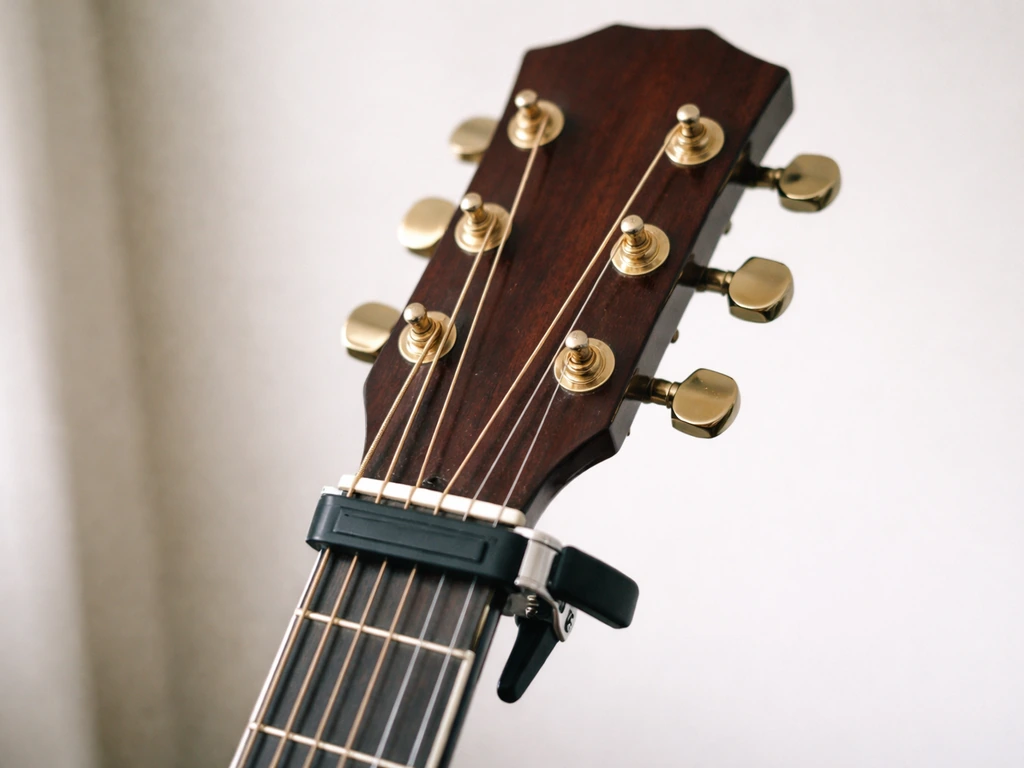
Tune your guitar to standard tuning: E A D G B E, low to high. No alternate tuning is needed for this song. Every beginner arrangement I have seen uses standard tuning, and the open chord shapes in the key of A sit very naturally in that position.
Capo use is optional. Cohen's original recording sits in a range that works fine without one if you are just playing solo. If you want to sing along and the key of A feels too low or too high for your voice, a capo at the 2nd fret shifts everything up to B, and a capo at the 5th fret puts you in D. Start without a capo, get the chord shapes locked in, and only add the capo once you are playing the song from memory and want to match a specific vocal range.
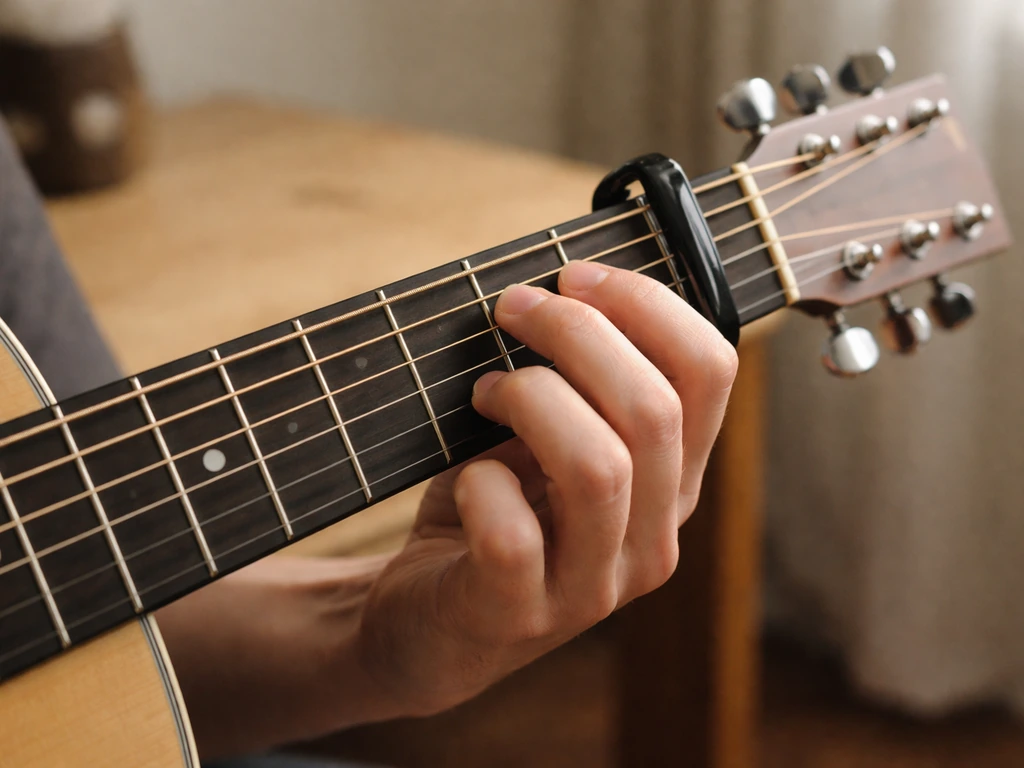
Your starting position is open position, meaning your fretting hand sits near the nut (the top of the neck). All the chords you need are open chords, so no barre chords are required. That is good news if you are still building hand strength.
The chords you need and how to practice the groove
The core chord set
The verse and chorus of 'Bird on the Wire' revolve around four chords. Learn these shapes first before you worry about strumming or timing.
| Chord | Fingers (fret / string) | Quick tip |
|---|---|---|
| A | Index finger bars strings 2, 3, 4 at fret 2 (or use three fingers across fret 2) | Make sure string 1 (high E) rings open |
| E7 | Index on string 3 fret 1, middle on string 5 fret 2 | Let strings 1, 2, 4, 6 ring open |
| D | Index fret 2 string 3, middle fret 2 string 1, ring fret 3 string 2 | Avoid strumming string 6 (low E) |
| Asus4 | Same as A but add pinky or ring finger on string 1 fret 3 | Lift that added finger to return to plain A |
| Bm | Barre fret 2 across all strings, ring finger fret 4 string 2 | This appears later in the song; skip it until the core four feel easy |
The verse loop you will play most of the time is: A, then E7, then A, then D. That four-chord cycle repeats through most of the song. The hook lyric maps directly onto it: 'Like a [A] bird on the [E7] wire, like a [A] drunk in a midnight [D] choir.' Asus4 appears as a passing chord just before you return to A at the end of some lines. It adds a nice little color without changing the overall feel.
The strumming pattern

The song is in 3/4 time, which means three beats per measure, not four. If you are used to 4/4 pop songs, this is the main adjustment to make. Count '1, 2, 3' over and over instead of '1, 2, 3, 4.'
The beginner strumming pattern is down-up-down-up, counted as: down on beat 1, up on the 'and' of beat 1, down on beat 2, up on the 'and' of beat 2. You can then let beat 3 breathe (a lighter strum or a rest) before starting the cycle again. The simplified version is just three deliberate downstrokes, one per beat, while you are learning chord transitions. Add the ups only once the chord changes feel automatic.
Here is the way I learned it: count out loud while you strum. Say '1-and-2-and-3' and match your pick to each syllable. The 'and' counts get upstrokes, the numbers get downstrokes. Even just tapping your foot on the downbeats while you practice will lock in the 3/4 feel faster than almost anything else.
Drilling the chord changes
Practice the A-to-E7 change first because it is the most frequent move in the song. Set a timer for two minutes and just switch back and forth between those two chords, strumming once per beat. Once that feels fluid, add D into the rotation: A, E7, A, D, repeat. Do not add the strumming pattern until you can make those chord changes without looking at your hands or pausing.
Playing the main melody line

Cohen's 'Bird on the Wire' is primarily a chord song, not a lead-guitar song. The 'melody' most guitarists play is actually built into the chord changes themselves, with the top note of each chord carrying the tune. That means if your chord shapes are clean and your chord-to-chord timing is right, the melody is already happening without you playing a separate lead line.
That said, if you want to pick out the vocal melody as a single-note line, it sits mostly on strings 1 and 2 (the two thinnest strings) in the first and second position. The main phrase for 'like a bird on the wire' moves roughly like this on string 2: fret 2 (the note B), open (A), fret 3 (C), back to fret 2 (B). That is a simplified version, but it captures the descending, questioning shape of the line. Play it slowly with a pick or your fingertip, and match each note to the syllable of the lyric as you hum or sing it. Your ear will tell you if a note is off.
The cleanest way to practice the melody is to play it without the chord shapes first, purely as single notes, until it sounds recognizable at a slow tempo. Then try layering it back over the chord shapes by letting the top strings ring as part of your chord strum. That hybrid approach, part chord and part melody, is exactly what Cohen's fingerstyle arrangements do and it sounds great even at a beginner level.
Timing, feel, and the mistakes that make it sound wrong
The song sits at around 128 BPM, but in 3/4 time that feels slow and spacious, almost like a gentle waltz. The biggest mistake most beginners make is rushing, especially on the chord changes. When the chord change is hard, there is a natural instinct to slow down, make the change, and then speed back up. That creates a lurching, uneven feel that kills the groove immediately.
The second most common mistake is muting strings accidentally. The A chord in particular is easy to mute if your index finger sits too flat and deadens the high E string. Check each chord shape by picking the strings one at a time after you form the shape. Every string should ring clearly. If one is muted, adjust the angle of your finger until it rings.
- Rushing through chord changes: keep your strumming arm moving at a steady pace even if the chord is not fully formed yet
- Muted strings on the A chord: arch your fingers more so only the fingertips touch the fretboard
- Forgetting the 3/4 time: if it starts sounding like a march instead of a waltz, stop, count '1-2-3' out loud, and reset
- Skipping the Asus4 variation: it sounds like a plain A if you leave it out, but adding it gives the song its characteristic open, unresolved feel
- Strumming the low E string during the D chord: it clashes badly; angle your strum to start from string 5 (A string) instead
One thing I found surprisingly helpful: record yourself on your phone for 30 seconds, then listen back. You will hear timing drift and muted strings immediately. It is uncomfortable to listen to yourself at first, but it is faster than any other feedback method.
A simple practice plan to get you playing today
Follow this in order. Do not skip ahead to the full song until each step feels comfortable. 'Comfortable' means you can do it without stopping to think.
- Warm up for 3 to 5 minutes: play through each chord shape (A, E7, D, Asus4) slowly, picking each string individually to confirm every note rings clean. This doubles as a hand warm-up and a chord-shape check.
- Drill A-to-E7 at 60 BPM: set your metronome (or a free app) to 60 BPM. Strum A once per beat for two beats, then E7 for two beats. Repeat for two minutes. Increase to 80 BPM once it is effortless.
- Add D into the loop: practice the full verse cycle A, E7, A, D at 60 BPM with one downstroke per beat. Two minutes. Increase to 80, then 100 BPM over successive sessions.
- Add the strumming pattern: once the chord loop at 100 BPM feels easy with single downstrokes, introduce the down-up pattern. Drop the tempo back to 70 BPM when you add it. The pattern feels new and that is normal.
- Play through the song with the lyric: use a chord sheet and play the whole song from start to finish, even if it is messy. Doing a full run, even imperfectly, trains your brain on the song's shape.
- Target tempo and progress check: aim to play the full verse loop cleanly at 100 to 110 BPM with the strumming pattern before pushing toward the song's 128 BPM feel. If you practice 20 minutes a day, most beginners hit that target in five to seven days.
If the melody line interests you, treat it as a separate five-minute block at the end of each session. Play it slowly as single notes, match it to the lyric, and gradually speed it up. Keep it separate from chord practice at first so you are not trying to do two new things at once.
Once you can play the basic four-chord loop and keep the 3/4 strumming steady, you can even sing along while your guitar “sings” through the melody built into the chord shapes how to play and <a data-article-id="099895FE-B68B-488E-8703-EA5ADF0F381B">your bird can sing on guitar</a>. If you want another similar option to try after this, use this guide for how to play bird song on guitar as a next step.
Where to go next
Once 'Bird on the Wire' feels solid, you are in great shape to explore other bird-titled songs on guitar. Leonard Cohen's style shares a lot of DNA with other chord-melody acoustic songs, and the open-position chord shapes you just learned (A, E7, D, Bm) come up constantly.
Songs like 'Free as a Bird' use similar open-chord approaches in a slightly different feel, and if you enjoy picking out single-note melodies, bird-themed pieces written specifically for melody instruments are also worth exploring. If you want a recorder version, start by finding the right notes for the melody and then practice them one bar at a time with steady breath control bird-themed pieces written specifically for melody instruments.
The chord vocabulary and sense of timing you built here transfers directly.
Keep the metronome running, record yourself every few sessions, and resist the urge to speed up before the chord changes are clean. The slow, waltz-like groove of 'Bird on the Wire' actually rewards patience more than most songs. Get it clean at a modest tempo and it will sound genuinely beautiful, which is a better win than playing it fast and sloppy.
FAQ
If I accidentally pick a different “Bird on the Wire,” how can I confirm I’m playing the Leonard Cohen version?
Check for the key-of-A feel and the signature lyric “Like a bird on the wire, like a drunk in a midnight choir.” Most beginner guitar tutorials for Cohen also use a repeating A, E7, A, D cycle in 3/4 time, with occasional Asus4 flavor near the end of lines.
Do I need to use fingerpicking, or will the down-up strumming approach work?
Strumming works for a beginner arrangement. If you want more of the “chord-melody” texture later, lightly reduce the strum on beat 3 so the top notes ring, instead of switching to full fingerpicking right away.
My E7 sounds muddy or dead. What’s the usual cause and fix?
E7 often becomes unclear when one finger blocks a string too much or lands at the wrong fret edge. Form the chord, then pluck each string individually while the chord is held. Adjust finger pressure and angle until every note rings clearly, especially on the top strings.
Is there a way to practice the 3/4 rhythm without strumming the full pattern immediately?
Yes. Practice only your right-hand timing as “one, two, three” with three gentle downstrokes, then add upstrokes only after chord changes are automatic. Another option is to keep your foot tapping on beats 1, 2, and 3 while you switch chords silently or with very light string touches.
What should I do if the chord changes feel hard even when I slow down?
Reduce the problem to one transition at a time, then lock it with “hold time.” For example, switch A to E7 and keep the E7 shape for a full measure before changing again, then repeat. Once that feels stable, reintroduce the full A, E7, A, D loop.
How can I avoid rushing when I get to a tough chord change?
Use a temporary metronome rule: never speed up after a miss. Instead, pause for one beat (or strum only once on the next clean beat) and continue. This prevents the common lurch where timing collapses after an adjustment.
Do I need to mute strings intentionally, or should every string ring all the time?
Let as many strings ring as possible for clear chord tones, but keep unwanted noise controlled by finger placement and light touches. If A keeps getting muted, focus on keeping the index finger from flattening and covering the high E string; the goal is “clear ring,” not heavy pressure.
Can I play it with a capo, and how do I keep the chord shapes consistent?
You can, and the article’s starting points are 2nd fret (up to B) or 5th fret (up to D). The key detail is to keep using the same chord shapes after you place the capo, because the capo shifts pitch while your fingering stays in the same open-position framework.
What tempo should I use when practicing, since it’s around 128 BPM?
Start slower than you think you need, then increase gradually. A practical approach is to begin at a tempo where you can change chords cleanly on every beat without looking. Once you can play the loop end to end with stable timing, raise the metronome by small steps.
How do I practice the melody line if I’m not confident with single-note playing yet?
Do a two-stage workflow: first play the suggested notes on string 2 alone at a slow tempo until they sound like the phrase, then add the chord shapes back underneath by keeping the chord hand in position while you let the top strings ring.
I want to sing it, but my voice is still off. Which practical adjustment should I try first?
Try capo before changing chord shapes. Start with no capo, then use a capo at the 2nd fret or 5th fret to find a comfortable key range, and only after that fine-tune your timing and strumming volume so the vocal lands comfortably on beat 1.
Next Article
How to Play Blue Bird on Recorder: Fingering Tips
Step by step recorder tutorial for Blue Bird with fingerings, rhythm tips, and fixes, plus cross-instrument confusion gu