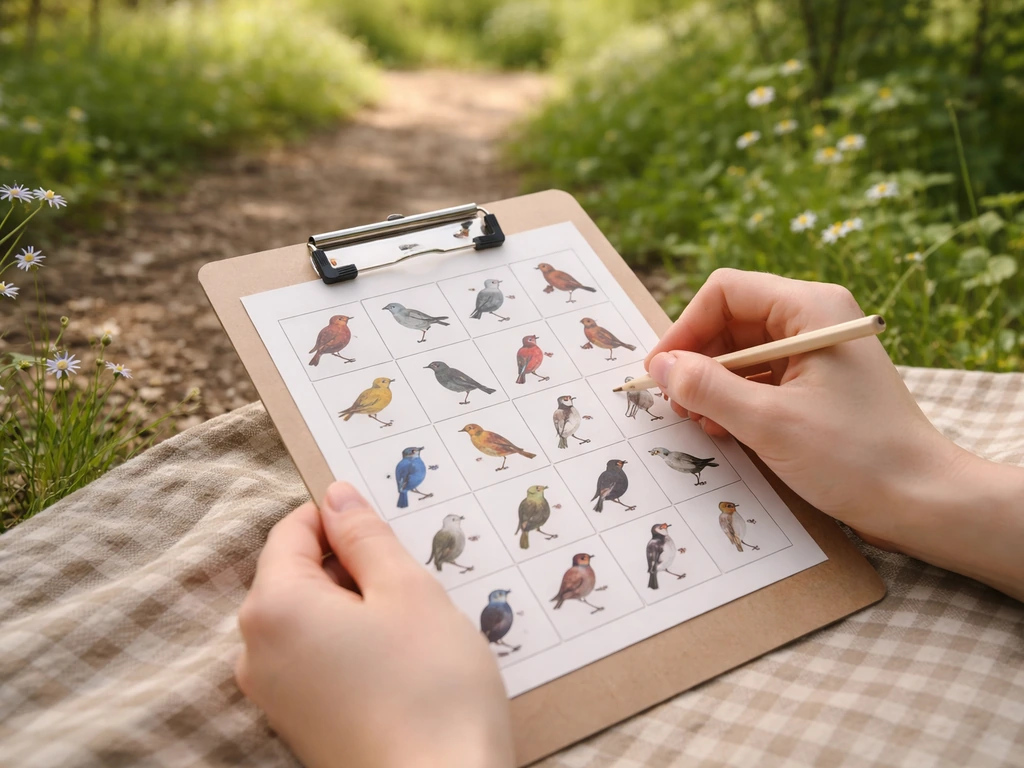
Bird Bingo is a nature-based bingo game where players watch for real birds (in a backyard, park, or garden) and mark them off on a grid card instead of calling out numbers. The first player to spot enough birds to complete a row, column, diagonal, or full card wins. You can play it in about 20 minutes with nothing more than a printed or hand-drawn card, a pencil, and a patch of outdoor space where birds show up.
How to Play Bird Bingo: Beginner Rules and Tips

Marcus Hendricks
6 May 2026
What Bird Bingo is and what you need to play
Unlike traditional bingo where someone calls random numbers, Bird Bingo uses the birds around you as the "caller." You fill a grid with bird names before you go outside, then head out and spot them in real life. Every bird you see or hear that matches a square on your card gets marked off. It's part game, part nature walk, and it's genuinely one of the easiest ways to get hooked on bird watching. The National Park Service uses a version of it as a 20-minute outdoor activity for kids ages 3 to 12, but it works just as well for adults and families.
Here's what you need to play a basic round:
- A bingo card for each player (printed from a source like Cornell Lab or hand-drawn on paper)
- A pencil or pen to mark off birds as you spot them
- A list of local birds to populate your card (more on this below)
- A phone with the Merlin Bird ID app installed (free, from Cornell Lab) for identification help
- An outdoor space where birds are active: your backyard, a local park, a garden, or even a schoolyard
- Optional: a simple field guide or printed bird pictures if you want to go low-tech
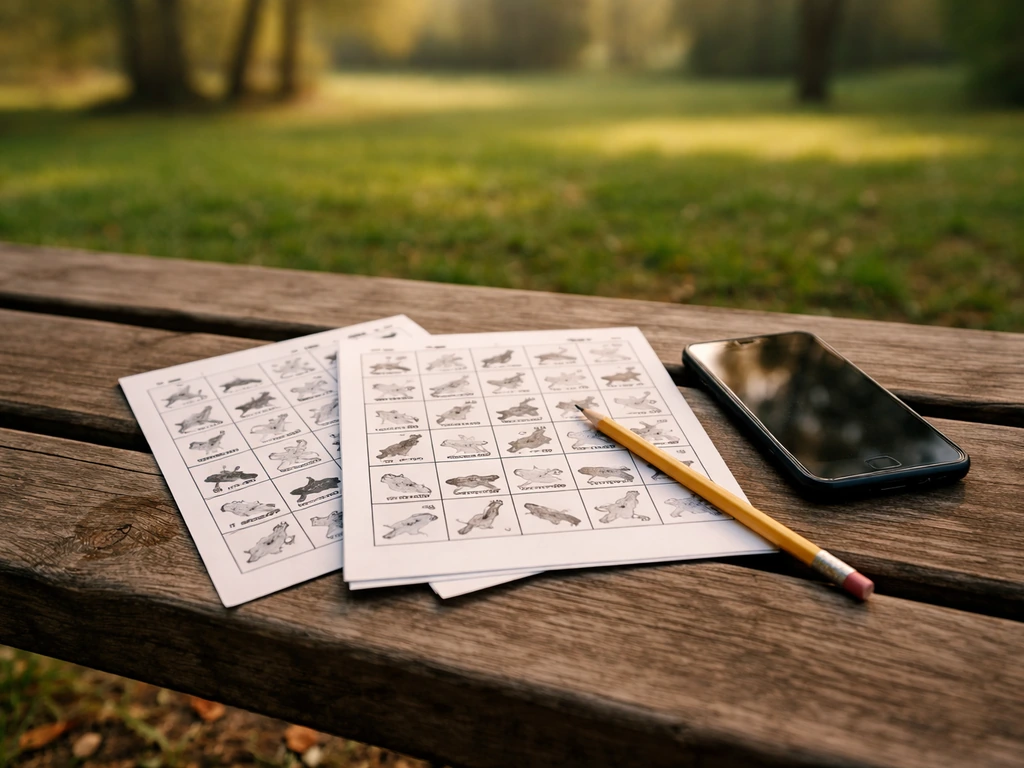
That's really it. No special equipment, no expensive gear. If you don't have a printer, you can write bird names directly into a hand-drawn grid and pull up bird pictures on your phone screen to help with identification. Chirp's Garden Bird Bingo specifically suggests this as a no-printer option, and it works perfectly well.
How to set up your Bird Bingo card and materials
Setup is the step most beginners rush through, and it's actually the most important part. A well-built card gives you a realistic shot at bingo. A poorly built one just frustrates everyone when half the birds never show up.
Step 1: Build your local bird list
Open the Merlin Bird ID app, tap "Explore," then set today's date and your current location. From there, filter by "Likely Birds" to see which species are realistically expected in your area right now. This is the list you draw your card birds from. It's a game-changer for beginners because you're not guessing. You're using real data on what birds are around you today.
Step 2: Choose your grid size

The most common sizes are a 3x3 grid (9 birds, faster games, great for kids and beginners) or a 4x4 or 5x5 grid (more birds, longer play, better for experienced birders). Cornell Lab's classic version uses a 3x3 grid. BirdsCaribbean's version uses a 4-in-a-row win condition on a larger grid. Pick what fits your group.
Step 3: Fill in your card
Draw your grid on blank paper or use a printed template. Write one bird name per box, choosing from your Merlin "Likely Birds" list. Each player should fill in their own card independently so no two cards are identical. That's what creates the competition. Here's the key tip from Cornell Lab: be strategic about placement. Put the birds you're most likely to see near the center of your card or in positions that overlap multiple potential winning rows. A house sparrow in the center square is more valuable than a rare warbler in the corner.
Step 4: Prep your identification tools
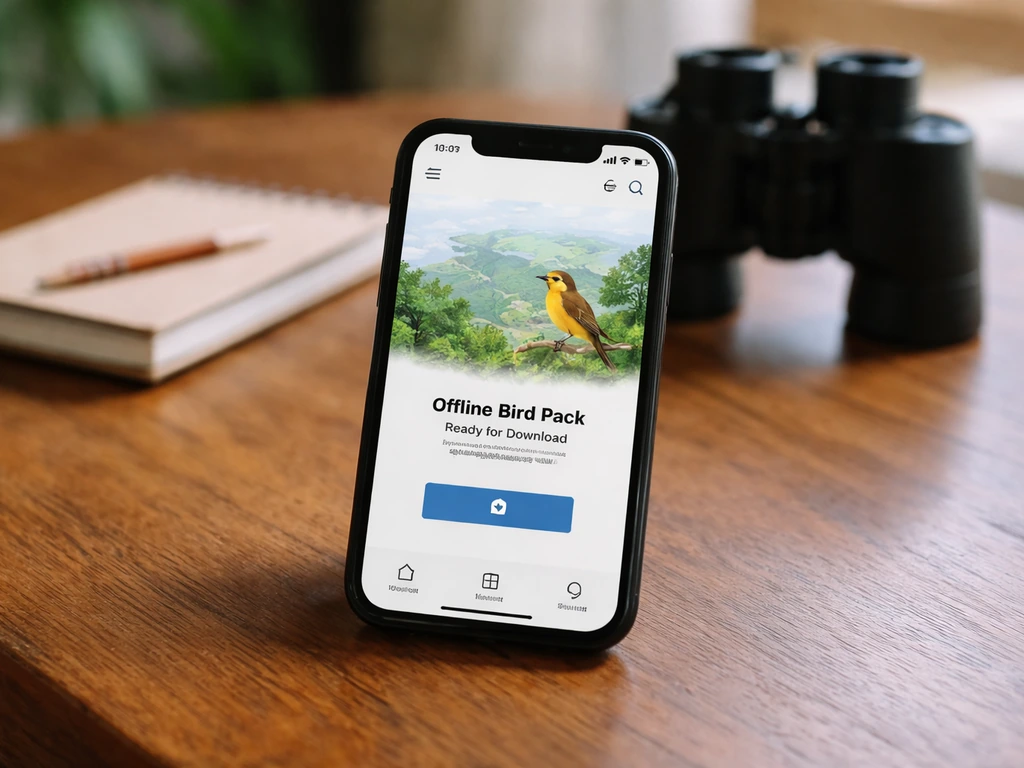
Before you head outside, make sure Merlin is set up and ready. Download the offline bird pack for your region (it's free) so the app works without cell service. If you're playing with young kids, print out small pictures of each bird on the card and tape them next to the bird names. That visual reference saves a lot of confusion in the field.
Step-by-step gameplay: calling, marking, and winning
Once your cards are ready, gameplay is simple. Here's how a full round runs from start to finish.
- Head outside to your chosen spot. Everyone brings their card, a pencil, and their phone.
- Start watching and listening. There is no "caller" in the traditional sense. Birds you actually see or hear in real life are what trigger your marks.
- When you spot or hear a bird, identify it using Merlin or field marks (more on this in the next section). If it matches a square on your card, mark it off.
- All players mark simultaneously. You don't take turns. Everyone is watching the same environment and marking their own cards in real time.
- Call out bird sightings to the group. When someone spots a bird, they say it out loud so other players can mark their cards too if that bird is on them. This is a team-friendly rule and it speeds up the game.
- Keep marking until someone completes their win condition (see below).
- When a player gets bingo, they shout it out and verify their marks with the group.
Win conditions you can choose from
Bird Bingo has several win modes and you should agree on one before starting. Chirp's Garden Bird Bingo lays out three clean options that work well in practice:
| Win Mode | How to Win | Best For |
|---|---|---|
| Full Card | First to cross off all birds on the card | Longer sessions, smaller groups |
| Line Bingo | First to see 3 (or 4) birds in a row, horizontally, vertically, or diagonally | Shorter games, kids, quick rounds |
| Time Limit | Set a timer; whoever crosses off the most birds when time runs out wins | Groups with mixed attention spans or limited outdoor time |
For a first game with beginners or kids, Line Bingo on a 3x3 grid is the move. It usually wraps up in 15 to 20 minutes and keeps everyone engaged. Full Card mode works better when you have a dedicated birding session and a good spot with lots of activity.
Bird sounds and identification help during the game
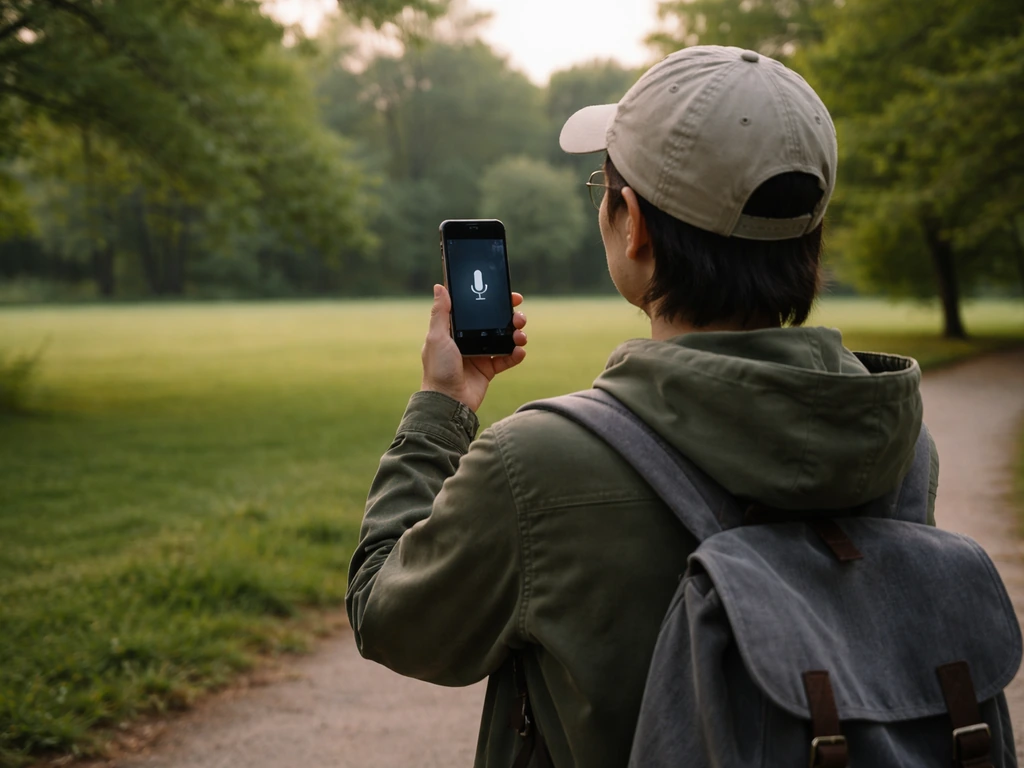
This is the part that worries most beginners, and honestly it shouldn't. You do not need to be an experienced birder to play Bird Bingo. The whole point of the game is to help you learn. That said, having a few identification tricks ready makes the game smoother and more satisfying.
Use Merlin Sound ID for birds you hear but can't see
This is the single best tool for Bird Bingo beginners. Open Merlin, tap "Sound ID," and point your phone toward where the bird sounds are coming from. Cornell Lab launched Merlin’s “Sound ID” technology in June 2021 [Merlin’s “Sound ID” technology launched in June 2021](https://www. birds.
cornell. edu/home/the-magic-of-merlin/). The app listens in real time and shows you live suggestions for which birds are singing or calling nearby. It works completely offline once you've downloaded your regional bird pack, so you don't need a cell signal.
When a suggested bird matches a square on your card, you have a strong case for marking it. I'd recommend confirming with a quick listen to the reference recording in the app before marking, especially if you're playing with competitive friends.
Use field marks when you can see the bird
Cornell Lab's Bird Bingo activity teaches players to look for specific physical clues to identify birds. These are called field marks. Even if you don't know the bird's name yet, you can describe what you see and then match it. The key ones to check are:
- Wing bars: small horizontal stripes across the wings (present or absent)
- Head color: is the cap, face, or crown a distinct color?
- Beak shape: thick and seed-cracking, thin and pointed, long and curved?
- Overall size: smaller than a sparrow, sparrow-sized, robin-sized, crow-sized?
- Behavior: hopping on the ground, clinging to a tree trunk, hovering?
Once you have two or three of those details, run them through Merlin's Bird ID Wizard. You answer three simple questions (size, main color, what it was doing) and it narrows the field fast. Merlin also has Photo ID if you can get a clear shot with your phone camera.
When you're not sure: the honest rule
If you genuinely can't confirm a bird, don't mark it. The game is more fun and more meaningful when marks are earned. That said, with Merlin's Sound ID running and basic field marks in mind, you'll be surprised how quickly even complete beginners start confirming birds confidently. The Cornell Lab's Macaulay Library has recordings of over 4,800 bird sound excerpts in its sound guide, and Merlin draws on that same library, so the identification quality is excellent.
Making Bird Bingo more fun: rule variations and difficulty levels
The basic game is solid, but a few tweaks can make it feel totally different depending on your group. Here are variations that are actually worth trying, not just gimmicks.
Easier versions for kids and total beginners
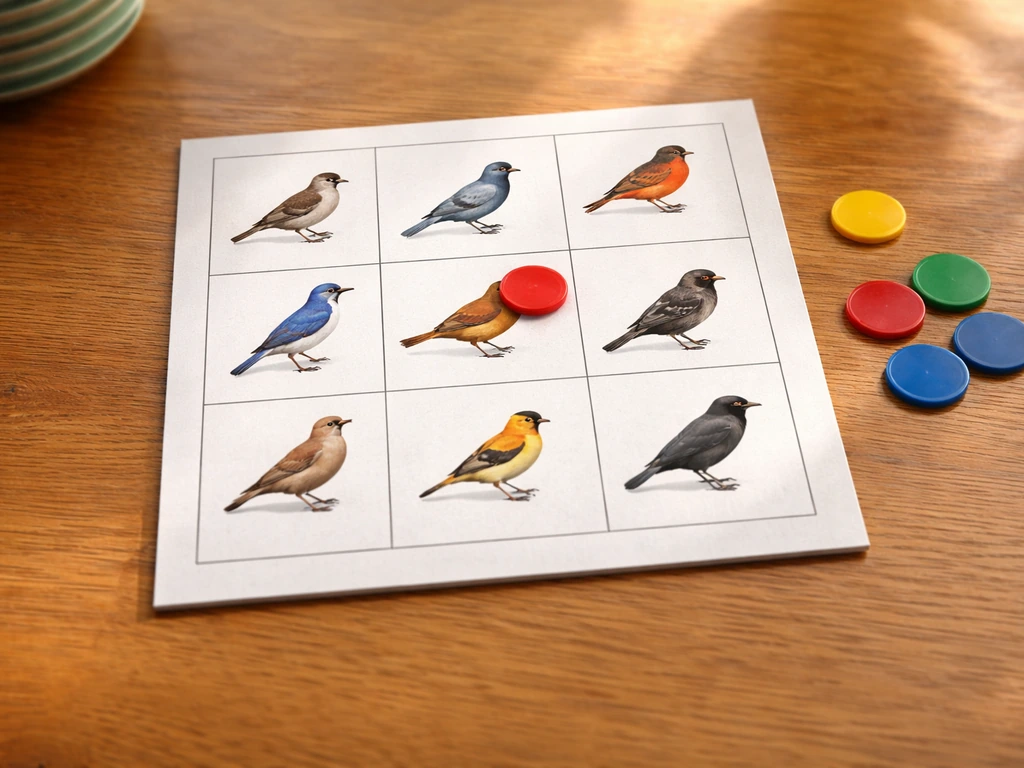
- Use a 3x3 grid with only very common birds (house sparrow, pigeon, robin, crow, etc.) so marks come quickly
- Allow a bird to count if anyone in the group identifies it, not just the person marking
- Include non-species squares like "Bird Singing," "Bird Flying Overhead," "Bird in a Tree," or "Bird Eating" (borrowed from BirdsCaribbean's version) to make the game winnable faster
- Print picture cards alongside the grid so kids can match by picture instead of name
- Play with a time limit of 15 minutes to keep energy up
Harder versions for experienced birders
- Use a 5x5 grid with a mix of common and less common local species
- Require photo or sound evidence before marking a square
- Include behavior or ecology squares like "Bird carrying nest material," "Two species interacting," or "Bird foraging on the ground" (inspired by BirdsCaribbean's ecology-focused version)
- Play Full Card win mode only: no bingo until every single bird is spotted
- Add a points system where rare birds (flagged by eBird in your area) score double
Other fun formats to try
- Team play: pair an experienced birder with a beginner on the same card
- Season challenge: keep the same card for a whole week and see how many you can complete
- Sound-only round: marks can only be earned from birds you hear, not see (great for training your ear)
- Location rotation: play a round in the backyard, then move to a nearby park for a second round with fresh cards
Beginner tips and mistakes to avoid
I've watched a lot of first-time players make the same avoidable mistakes. Here's what actually makes a difference.
Tips that make a real difference
- Download Merlin and the offline bird pack before you leave home. Do not wait until you're outside with no signal.
- Play in the morning. Birds are most active in the first two hours after sunrise. Mid-afternoon is the worst time for bird activity.
- Stand still and listen for at least two minutes before moving. The biggest mistake beginners make is walking too fast and flushing birds before they can be identified.
- Put your most common local birds in the center of your card and along diagonals, where they can contribute to more potential winning lines.
- Agree on win conditions before you start. Nothing kills the vibe faster than arguing about what counts as bingo mid-game.
- Keep the game moving. If the group is struggling to spot birds, shift locations. Even moving 30 meters can reveal a totally different set of birds.
- If you're playing with kids, narrate what you see out loud. "I can see a small brown bird with a striped head, hopping on the ground" helps everyone tune in and learn at the same time.
Common mistakes to avoid
- Filling your card with rare or uncommon birds just because they sound exciting. If they don't show up, you can't win. Stick to likely species from Merlin's list.
- Marking a bird before confirming the ID. A quick Merlin check takes 10 seconds and prevents arguments.
- Playing in a spot with no bird activity. Concrete car parks, fully paved areas, and interiors of dense forests with no edge habitat all have low bird activity. Go where birds have food, water, and cover.
- Using different cards with wildly different difficulty levels. If one player loads up on common sparrows and another picks rare warblers, the game isn't fair.
- Ignoring bird sounds. A lot of beginners only watch and miss birds they could be hearing. Let Merlin Sound ID run in the background while you scan visually.
- Forgetting to share sightings with the group. Bird Bingo is more fun as a shared experience. Call out what you see so everyone has a chance to mark their cards.
Bird Bingo is one of those rare activities that's simple enough to explain in five minutes but rewarding enough to come back to again and again. Once you've played a few rounds, you'll notice you're starting to recognize birds without needing to check the app every time. That's the whole point, and it sneaks up on you in the best way.
If you enjoy the sound identification side of things, it's worth exploring more about how bird calls and songs work as a standalone skill. If you want to level up beyond Bird Bingo, you can also learn how to play bird on a wire by following the basic rules for this game. If you want to take it further, learn how to play Fly Like a Bird by practicing short, repeatable moves that match how different birds move.
If you want the quickest overview, this guide on how to play Bird Bingo walks you through setup, calling, and winning. If you want to go beyond the basics, check out this guide on how to play the bird opening and what to listen for. If you want to take it further, learn how to play bird song so you can practice recognizing melodies and calls on your own.
If you're curious about a specific species, this guide on how to sing green finch and linnet will help you practice the right notes how bird calls and songs work. There's a lot of crossover between Bird Bingo and other bird-based activities once you start building your identification confidence. If you're looking for a similar approach, this guide on how to play Little Bird can help you translate the skills.
FAQ
What should we do if two people complete a bingo at almost the same time?
If multiple players mark the same square on their own cards, that does not guarantee a shared win. Decide up front whether you are racing purely for the first completed line or whether “first to complete any winning pattern” ends the round immediately for everyone. For groups with mixed experience, a common compromise is to stop as soon as someone completes the chosen win mode, then let everyone finish marking any birds they already confirmed to keep it fair.
Can I play Bird Bingo without the Merlin app?
Yes, you can play without Merlin. Pre-load a small, printed “likely birds” list using any local bird guide you already have, and use field marks plus sound cues from your own phone recordings (or your memory) to confirm before marking. The biggest adjustment is to keep your card birds realistic, because without Merlin’s location-based filtering you will have more mismatches and fewer legitimate marks.
How strict should we be about confirmation before marking a square?
For best results, mark only birds you can confirm via a matchable sound or clear field marks. If you’re playing with kids, you can allow a “gray mark” option (like a pencil dot) that does not count toward bingo until they get confirmation with Sound ID or a better view. This reduces guessing and makes winners feel earned.
If the same bird shows up multiple times, can players keep marking extra squares?
Set a simple “marking rule” and stick to it, for example, one confirmation per square, and a bird can only be used once even if it appears again. That prevents a common frustration where someone keeps re-confirming the same obvious bird while others struggle to see less frequent species.
Where should we go to get enough different birds for a full game?
Choose your venue based on access to habitat variety, not just bird density. A location with trees, shrubs, and open ground typically produces more different species than a fully open lawn. If you are going to stay in one spot, pick a place where birds are likely to perch (fence lines, trellises, feeders) and agree on a walking radius so you are not comparing “different zones” unfairly.
What can we do if the game is stuck and nobody can get close to bingo?
If a card feels “dead” (too many squares never appear), you can pause and do a mid-game reset once. For example, let players cross off one or two species that are clearly not happening and replace them with optional alternatives from your likely list. Keep the win mode the same, but write down what was swapped so nobody disputes the change later.
Can Bird Bingo be played at dusk or nighttime?
Yes, but keep it practical. Using a smaller grid (3x3) limits the number of unique birds you must see and usually works better for night play. Also, rely on sound-based identification if possible, and use low-light safety rules for everyone. If you cannot confirm sounds clearly, switch to daytime or shorten the session because nighttime bird calls are harder to verify confidently.
Should we use photo identification or sound identification first?
If you can get close enough for identification, use Photo ID sparingly and only for moments you can capture clearly. For far-off birds, trust Sound ID more, because small, distant photos often fail at the field mark level. A good workflow is Sound ID first, Photo ID second, mark only when either one matches confidently.
Why does Bird Bingo sometimes feel unfair or impossible for beginners?
A mismatch happens when your card birds do not match the birds that actually show up. To reduce that, build your card strictly from Merlin’s “Likely Birds” list for today, and avoid adding rare species even if you personally want them included. If you want variety, increase grid size rather than swapping in unlikely birds.
What is the best way to avoid mistakes when players mark squares in the moment?
Use a consistent “decision window,” like marking only birds you confirm within 60 seconds of hearing or spotting them. This prevents a common mistake where someone marks late based on memory, then disputes whether the bird actually matched. If a player is unsure, they should wait and re-check with Sound ID or field marks.
Next Article
How to Play Fly Like a Bird: Beginner Step-by-Step
Step-by-step drills to play fly like a bird with safe wing-flap movement, takeoff, glide practice, and fixes for beginne