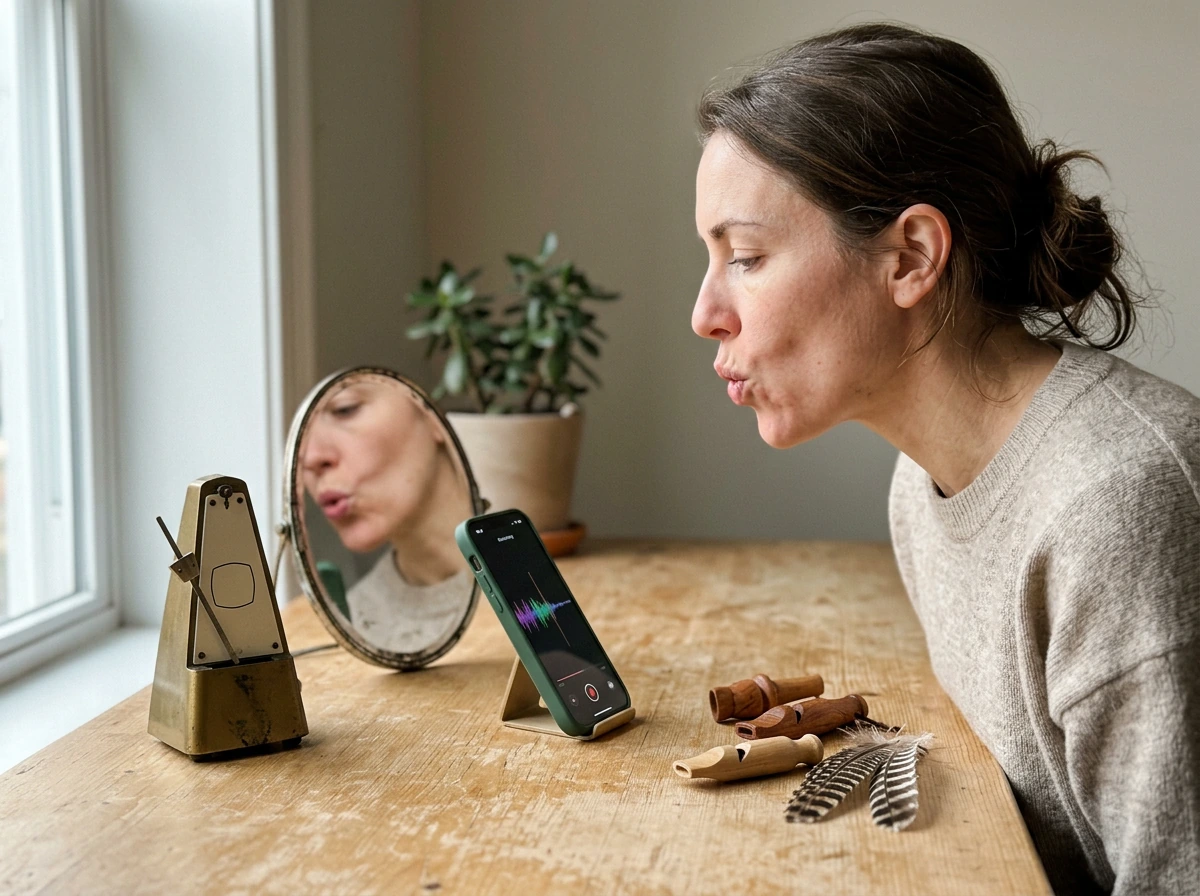
You can make convincing bird calls with your hands right now, no tools or special gear required. The core idea is simple: your cupped hands form an acoustic chamber that shapes and amplifies the sound your mouth produces, just like a resonance box on an instrument. Get the hand position right, add the right airflow or lip technique, and you get a bird-like call. Get it wrong, and you just get a weird noise or nothing at all.
How to Make Bird Calls With Hands: Step-by-Step for Beginners

Marcus Hendricks
23 Mar 2026

This guide walks you through the exact setups, step-by-step techniques, and troubleshooting tips so you can produce real results today. If you want to broaden your repertoire beyond one call, the same hand setups can help you produce different bird calls by changing pitch, timing, and airflow.
Hand setups and mouth positioning
There are two main hand setups beginners should know. Each produces a different type of call, and both are worth learning because they suit different bird sounds.
The cupped-hands cavity setup
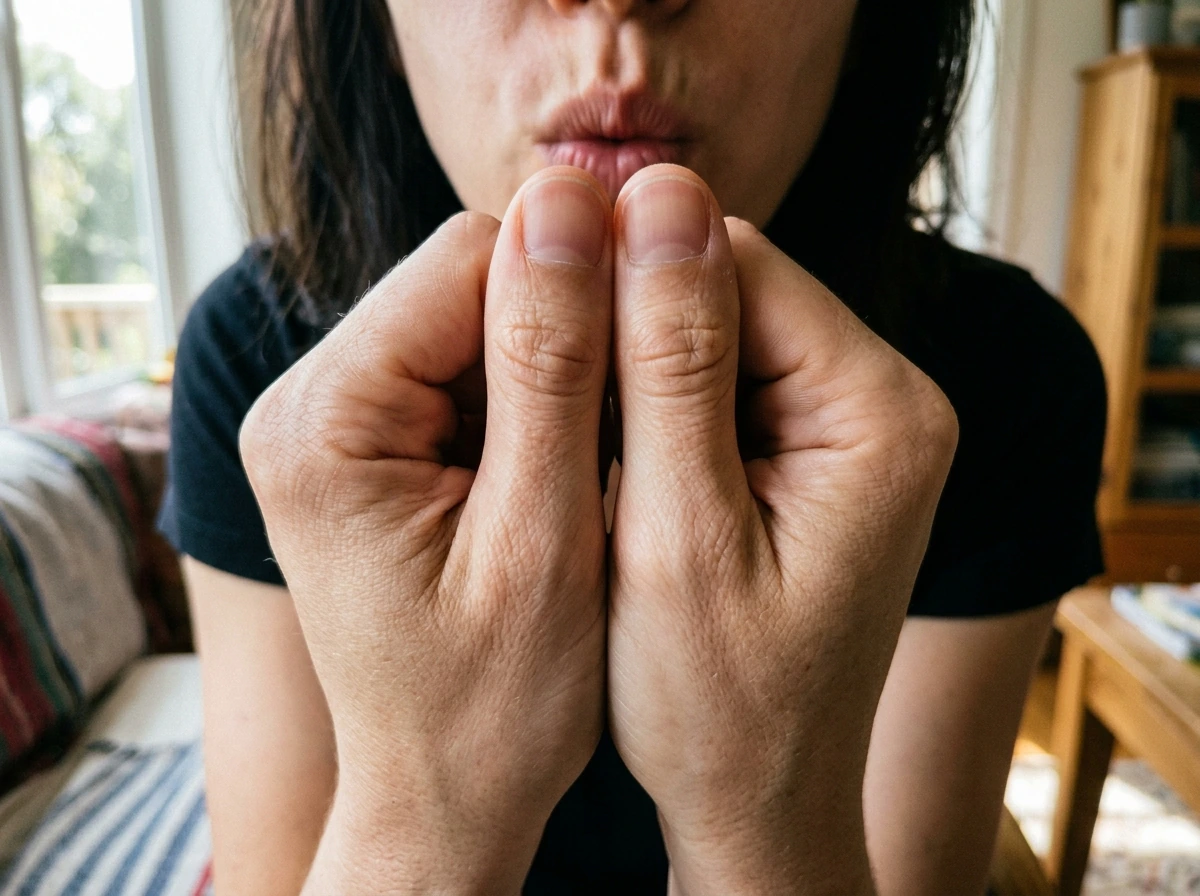
This is the classic hand-whistle style. Interlace your fingers so both hands form a hollow ball shape, with your thumbs side by side on top. The thumbs should be touching or nearly touching, creating a small gap between them. That gap is your sound exit point. Press your lips to the knuckle area just below that thumb gap, and blow through the cavity. The depth and closure of the cup directly control pitch: closing the cup more decisively raises the note, while a looser, more open cup gives you a lower, rounder tone. Think of it like adjusting the mouth of a bottle. This setup works best for mimicking owls, doves, and other birds with smooth, sustained calls.
The loose-fist kiss-squeak setup
For shorter, sharper bird sounds (the kind that grab a bird's attention fast), use a loose fist. Hold one hand up with your thumb and curled index finger facing toward you. Press your lips against the fleshy pad between your thumb and index finger and make a slow, noisy kissing sound, the kind of lip-smacking squeak you might accidentally make when you kiss someone's cheek. This is sometimes called a kiss-squeak, and it produces a high, short, attention-grabbing sound that mimics alarm or contact calls. It is extremely effective for drawing curious birds closer, which is why experienced birders have used this technique for decades.
Step-by-step bird call techniques for beginners
Technique 1: The cupped-hand whistle call
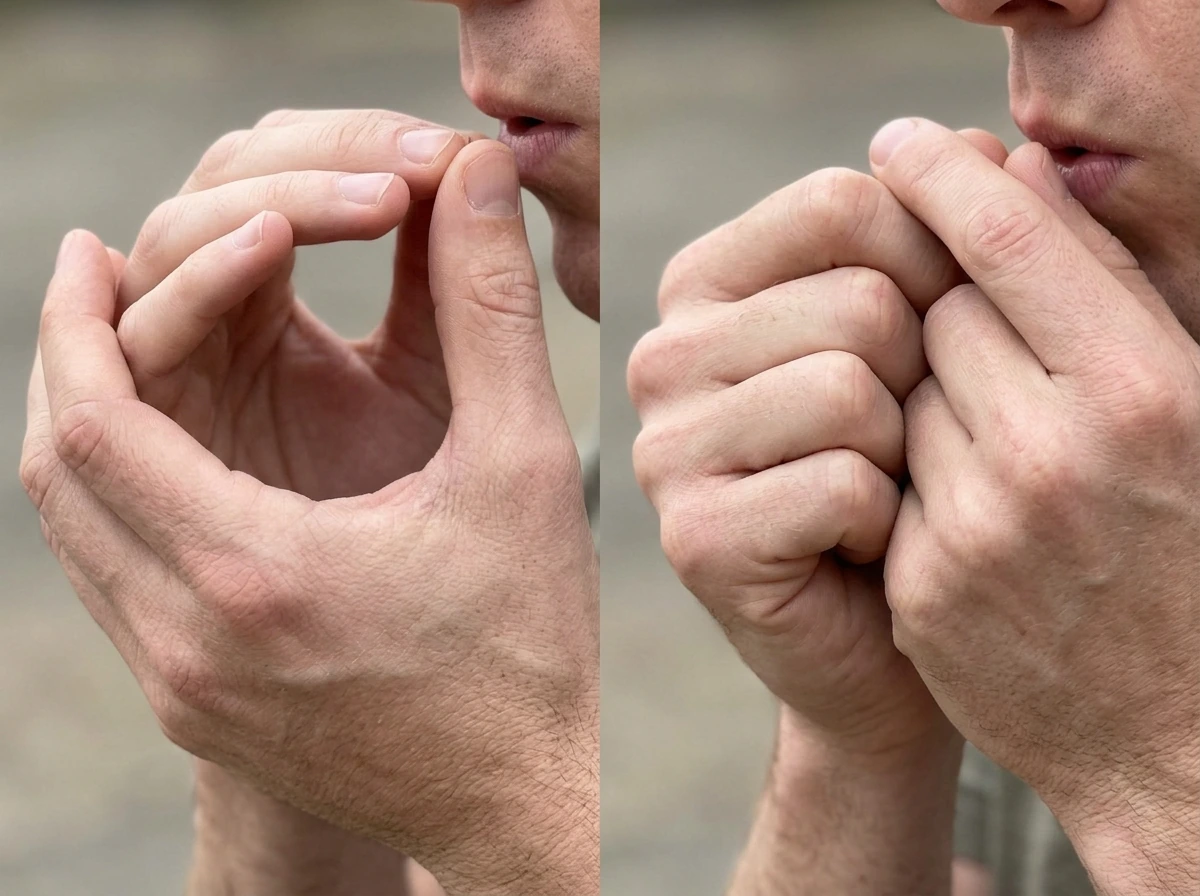
- Clasp your hands together loosely with fingers interlaced, forming a hollow cavity inside.
- Place your thumbs side by side on top, tips touching, with a small gap (about 3–5mm) between them.
- Bring your hands up to your mouth and press your upper lip against your top knuckles, just below the thumb gap.
- Blow a steady, moderately forceful breath through the gap. Weak airflow produces nothing; you need enough pressure to create turbulence inside the cavity.
- Adjust pitch by squeezing your hands more tightly together (higher note) or relaxing the cup (lower note).
- To mimic a bird call pattern, vary the rhythm: a short burst followed by two longer ones sounds convincingly like several songbirds.
Technique 2: The kiss-squeak hand call
- Make a relaxed fist with your dominant hand, keeping it loose.
- Hold it up with your thumb on top and the gap between thumb and index finger facing your lips.
- Press your lips firmly against the fleshy skin at the base of the thumb and index finger.
- Draw in a short, sharp breath while pressing your lips against the skin, producing a squeaky sucking sound, or alternatively push air out in a slow lip-smacking motion.
- Repeat 3–5 times in a slow, steady rhythm to simulate a bird's contact or alarm call.
- Start at moderate volume, then reduce volume once you see a bird responding and moving closer.
Technique 3: Pishing with hand amplification
Pishing is one of the most effective beginner techniques for attracting songbirds. The sound itself is a drawn-out, slightly hissing "piiiiish" or "psssht" made on one long exhale. Cup your hands loosely around your mouth (not fully sealed, just framing it) to direct and slightly amplify the sound. Inhale quickly, then push the sound out as you exhale: "pish, pish, pish" or "psst, psst, psst" repeated 3–5 times at a slow, even tempo. The National Geographic family birding guide describes it as something close to saying "piiiiiiish" in a drawn-out way. The cupped hands help focus the sound in one direction and add a subtle resonance that makes it carry further.
Bird-like sounds you can produce and how to change tone
Once you have the basic setups down, you can produce a range of bird-like sounds by making small adjustments. how to ring a bird Here is what changes what.
| Adjustment | Effect on sound | Best for mimicking |
|---|---|---|
| Close cup more tightly | Higher pitch, sharper tone | Warblers, small songbirds |
| Open cup loosely | Lower pitch, rounder tone | Owls, doves, pigeons |
| Increase airflow force | Louder, more projecting call | Carrying sound across distance |
| Reduce airflow, soften lips | Quieter, softer call | Close-range attraction, calm approach |
| Adjust index finger over thumb gap | Changes timbre and resonance | Fine-tuning to match a specific bird |
| Repeat in short bursts | Mimics alarm or contact calls | Chickadees, sparrows, wrens |
| Single long tone with slight vibrato | Mimics territorial or mating calls | Owls, mourning doves |
The science behind this is straightforward: adding a hand in front of or around your mouth acts as a funnel and changes the spectral properties of the sound, specifically lowering the maximum frequency compared to using your mouth alone. That is exactly what makes the hand technique sound more bird-like than a raw vocal attempt. You are literally reshaping the sound wave before it leaves your hands.
For specific target sounds, try these starting points: for a sharp "chek" sound like a Yellow-rumped Warbler, use a tight cupped fist and a short forceful pop of air with a hard "k" at the end. For something closer to the Northern Mockingbird's repeated phrases, loop a two-note whistle pattern using the cupped-hand setup, alternating between a slightly open and slightly closed cup to vary pitch.
Calling a bird toward your hand: timing, distance, and realistic behavior
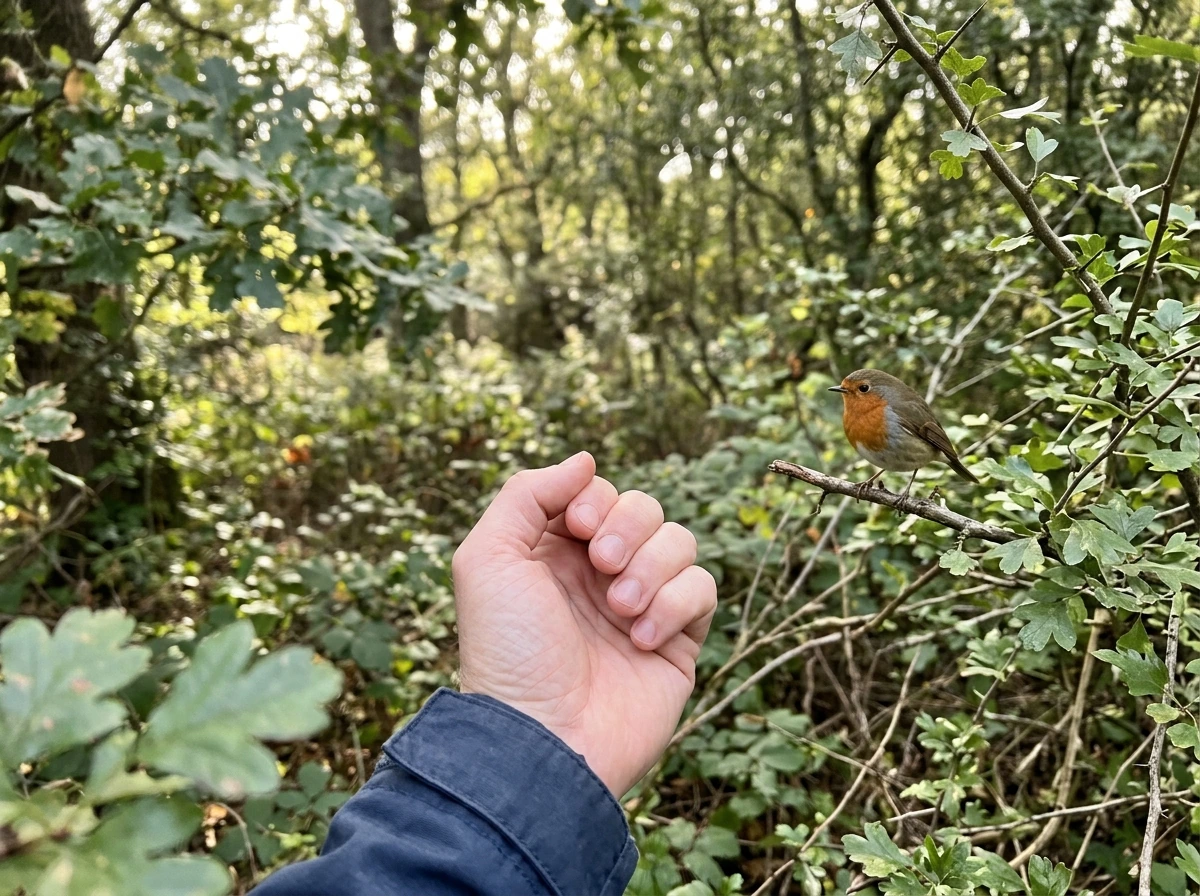
Getting a bird to approach you is a realistic goal, but it requires patience and a clear understanding of what actually works. Birds do respond to hand-and-mouth calls, particularly the kiss-squeak and pishing techniques, but they respond on their terms.
Distance matters. Research on vocalization-based bird attraction shows that birds respond most strongly when they are within a relatively close range, and one study found that over 80% of responses occurred within about 1.5 meters of the sound source. In practical terms, this means your call will be most effective when a bird is already nearby, not when you are trying to summon one from across a field. Start calling when you can already see or hear a bird in the area.
Timing your approach matters just as much as the call itself. Call 3–5 times, then go quiet and stay still. Movement is what spooks birds, not sound. If a bird responds by moving closer or calling back, drop your volume and slow your rhythm. Think of it as a conversation where you are matching the bird's energy, not overpowering it.
If you genuinely want a bird to land on or near your hand, consistency over days is the real strategy. Birds that visit the same feeding spot regularly will start to associate your presence with safety. Sit still, hold your hand out with seed in the palm, and use soft, low-volume calling to signal you are not a threat. Chickadees and nuthatches are the species most likely to land on a human hand in North America, and even they typically take multiple sessions before they feel comfortable enough.
One critical point on ethics: avoid calling near active nests. Prolonged calling near nesting birds can keep parents away from eggs or chicks, increase stress, and disrupt feeding behavior. The American Birding Association and Audubon both emphasize minimizing disturbance, especially during nesting season. If a bird is following you from spot to spot or seems agitated and flying back and forth repeatedly, stop calling. That is a sign of over-stimulation, and continuing is not fair to the bird.
No-hands alternatives and when they make more sense
You do not always need your hands to produce bird-like sounds. Pure vocal techniques, sometimes called pishing without hand amplification, work well in open areas where you need both hands free, like when you are holding binoculars or a camera. The raw "pish" syllable spoken through pursed lips is surprisingly effective on its own, particularly for small songbirds. You can also press your lips against the back of your wrist (no fist needed) and perform the kiss-squeak directly on skin, which works almost as well as the loose-fist method.
Commercial bird calls (small wooden or metal devices you blow or rotate) and smartphone apps with recorded bird sounds are the other no-hands options. These are more accurate in terms of matching a specific species' call, but they come with more ethical complexity. Apps and recorded playback can cause over-stimulation if overused, and some protected areas and birding organizations explicitly discourage or prohibit playback in sensitive habitats.
Audubon’s guidance for using birdcall apps also points out that “bad playback etiquette” includes continuous or loud broadcasting and waiting for a bird to fly in, and it notes that useful responses typically require being in or very near the bird’s territory continuous or loud playback and waiting for a bird to approach in its territory.
A peer-reviewed study on PubMed Central found that simulated birdwatchers’ playback can alter bird behavior, including changes in vocal behavior during playback trials [Apps and recorded playback can cause over-stimulation if overused](https://pmc. ncbi. nlm. nih.
gov/articles/PMC3797570/). For casual backyard birding and learning, hand-based methods are a better starting point because they are immediately available, ethically low-risk, and genuinely effective.
| Method | Hands needed? | Best for | Ethical risk |
|---|---|---|---|
| Cupped-hand whistle | Yes | Owl, dove, sustained calls | Low |
| Kiss-squeak (loose fist) | Yes | Alarm/contact calls, attracting nearby birds | Low |
| Pishing (vocal only) | No | Songbirds, hands-free situations | Low |
| Wrist kiss-squeak | No (mostly) | Quick use when hands are occupied | Low |
| Wooden/metal call device | No | Specific species, hunting contexts | Low to moderate |
| Smartphone playback app | No | Species identification, surveys | Moderate to high near nests |
A practice routine that actually works
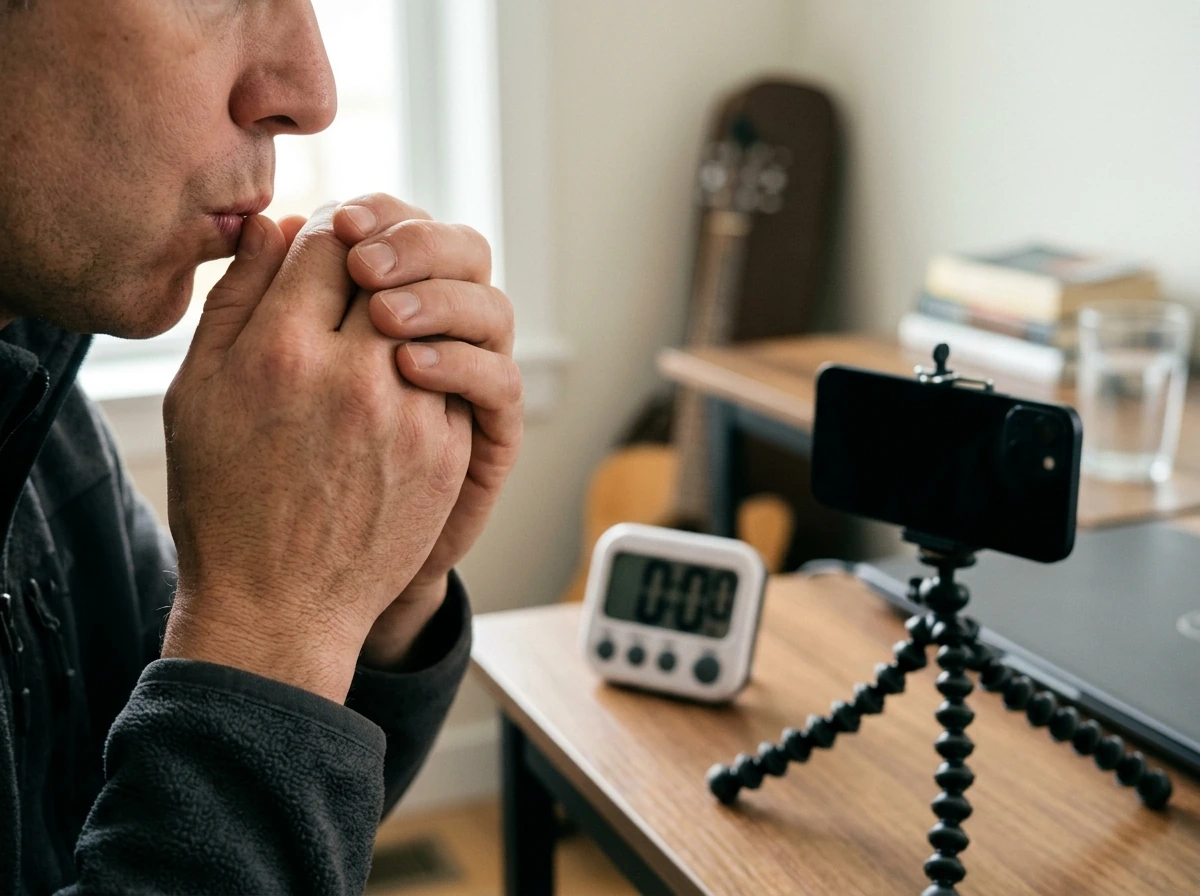
The biggest reason beginners fail at hand calls is inconsistent practice and no feedback loop. Here is a simple routine you can follow:
- Spend 5 minutes indoors just getting a clean tone from the cupped-hand whistle. You should hear a clear whistle, not a raspy leak. If you get no sound, you are either not blowing hard enough or your gap is too large. Close the cup slightly and increase airflow.
- Once you have a clean tone, practice varying pitch by opening and closing the cup while maintaining airflow. Try to hit three distinct pitches (low, mid, high) intentionally.
- Move to the kiss-squeak. Practice the sound on the back of your hand 10 times, aiming for a consistent, sharp squeak each time. If it sounds dull or muffled, press your lips more firmly against the skin.
- Take both techniques outside. Find a spot with bird activity (a park, backyard, or woodland edge), sit quietly for 2–3 minutes first, and then try your call 3–5 times. Wait 30–60 seconds between rounds.
- Listen for a response. Birds may call back, move closer, or both. If you get a response, reduce your volume by about half on the next call.
- Repeat this outdoor session 3–4 times per week. Most people start getting consistent bird responses within 1–2 weeks of regular practice.
Common problems and quick fixes
- No sound at all: Your airflow is too weak or the gap in your cupped hands is too large. Tighten the cup and blow more forcefully.
- Sound is raspy or unfocused: Your hands are not sealed enough around the sides. Make sure the only exit for air is the thumb gap at the top.
- Pitch is stuck on one note: You are gripping your hands rigidly. Relax and practice squeezing and releasing the cup while blowing.
- Birds seem startled and fly away: Your call is too loud or too fast. Start softer, slow your rhythm to 3–5 calls with long pauses between rounds.
- Kiss-squeak sounds wet or sloppy: Use less saliva and press your lips more firmly. A drier, firmer contact produces a cleaner squeak.
- You stop getting responses after the first session: You may be over-calling. Give the area a rest for a day and try again with shorter, quieter rounds.
How to use video and step-by-step guides effectively
Video tutorials on platforms like YouTube are genuinely useful for learning hand calls because you can watch exact hand positioning in real time, something written instructions can only approximate. When you watch a tutorial, focus on three things: where the lips make contact with the hand, how wide or narrow the thumb gap is, and how the instructor's hands move to change pitch. Pause and replay those moments rather than watching the whole video straight through.
Video tutorials on platforms like YouTube are genuinely useful for learning hand calls because you can watch exact hand positioning in real time, something written instructions can only approximate. When you watch a tutorial, focus on three things: where the lips make contact with the hand, how wide or narrow the thumb gap is, and how the instructor's hands move to change pitch. Pause and replay those moments rather than watching the whole video straight through.
Focus on the hand positioning for call accuracy in your practice.
For written step-by-step guides (like Wikihow-style articles), the photos or diagrams are the most valuable part. Read the step, look at the image, form the hand position yourself, and then try the sound before moving to the next step. Do not try to read all the steps first and then attempt everything at once. One step, one attempt, one adjustment.
One thing most tutorials do not tell you: the first clean sound you produce is the hardest. Once you have heard yourself do it once, your hands and mouth remember the position instinctively. So the goal of your first practice session is not to sound like a bird. It is just to get one clean, intentional tone.
Everything else builds from there. If you want the full process, start with this guide on how to make a bird caller and then refine your calls using the setups above. If you are specifically trying to master how to make a swallow bird call, use this same approach and dial in the note shape and timing how to make a bird caller.
If you want to go deeper on specific bird sounds to imitate, If you want to go deeper on specific bird sounds to imitate, related guides on how to make bird sounds with your mouth and hands, If you want to go deeper on specific bird sounds to imitate, If you want to go deeper on specific bird sounds to imitate, related guides on how to make bird sounds with your mouth and hands, and how to do different bird calls, cover species-specific techniques that pair well with what you have learned here.
If you want to go deeper on how to do the bird call for specific sounds, use this guide on how to do different bird calls as your next step. that pair well with what you have learned here.
FAQ
Why do I sometimes get no sound at all with the cupped-hand whistle?
Most often the thumb gap is too small (or fully sealed), or your lip contact is too far from the knuckle pad. Reopen the gap slightly and press your lips on the lower knuckle area, then blow with a steady breath rather than a hard burst, so the cavity actually resonates.
How can I control pitch more reliably when practicing the classic hand-whistle?
Make pitch changes by adjusting cup closure, not by moving your whole hands. Keep the thumb gap and lip contact point steady, then tighten the cup a little, hold for one note, and release back to your starting shape before repeating.
What’s the difference between pishing and the kiss-squeak, and when should I use each?
Pishing is a drawn-out hiss on a long exhale (3 to 5 repeats), it tends to attract or hold attention from small songbirds. The kiss-squeak is a short, high, noisy squeak, it’s better for immediate “check this out” contact-style attention. If birds are already nearby and look curious, use the kiss-squeak; if they’re just out of reach, start with pishing.
Why do my calls sound “wet” or muffled instead of bird-like?
You may be sealing your hands too tightly or letting your breath leak into the sides of the cup. Try framing the mouth more loosely (especially for pishing), keep the opening directed forward, and avoid pushing so much air that the lips collapse into a muffled buzz.
How loud should I call so I don’t spook birds?
Use the quietest version that still carries. A good rule is to call only after you already see or hear birds nearby, then stop after 3 to 5 calls and become still. If the bird backs away or repeatedly flies back and forth, lower volume immediately or stop.
Can I use these hand calls near feeders, and will that change what birds do?
Yes, but keep calls soft and brief. If birds are already coming to a feeder, over-calling can make them spend more time watching you than feeding. Once a bird pauses or looks toward you, reduce calling and let feeding resume, especially for timid species.
Is it okay to call at dawn or at night, and how does timing affect results?
Dawn is often effective because many birds are more responsive to communication. Nights and very early hours can increase stress for roosting or nesting birds, and your calls can travel unpredictably in the dark, so prioritize daylight and stop if birds seem agitated or silent.
Can I ring a bird or imitate multiple species in a single session?
You can switch sounds, but avoid rapid “sound roulette.” Make one attempt type, then pause and observe for 10 to 30 seconds before trying another. Frequent switching can confuse birds and looks like repeated disturbance rather than communication.
Do hand calls work in windy or noisy conditions?
Wind and background noise can swallow higher frequencies, so use slightly stronger airflow with the fist setup for sharp calls, and for pishing keep the exhale steady and long enough to create a continuous hiss. If you cannot hear your own call clearly, birds probably cannot either, so move closer or wait for calmer sound.
What’s the safest ethical approach if birds are following me or showing agitation?
If a bird tracks you from spot to spot, or is repeatedly flying back and forth with an alert, stressed posture, stop calling right away and give it space. Continuing can interrupt normal feeding and increase time spent on defensive attention.
How many practice attempts should I do before adjusting something?
Use a “one change at a time” loop. Try to produce one clean tone for about 5 to 10 seconds, then adjust only one variable (cup closure, thumb gap, or lip contact point) and retry. Avoid changing all variables at once, because you will not know what actually improved the sound.
If I want to attract birds to land near my hand, what should I do differently than standard calling?
Calling becomes secondary. Sit still, present seed in your palm slowly, and keep calls quiet and minimal so your presence stays predictable. It may take multiple sessions for species like chickadees or nuthatches to approach closely, and consistent routines usually beat louder or more frequent calling.
Next Article
How to Make Bird Chirping Noises: Voice Drills
Step-by-step voice drills for realistic bird chirps: breath, tongue, pitch, rhythm, pauses, and timing to sound natural.