You can memorize bird calls by picking a small set of target species, listening to each call in short focused sessions, labeling the sound with a mnemonic or phonetic phrase, and then testing yourself without the recording. That combination of active labeling, spaced-out practice, and cue-free recall is what actually builds long-term memory, not just passive listening on repeat.
How to Memorize Bird Calls: A Step-by-Step Training Routine

Marcus Hendricks
3 May 2026
Why bird calls are hard to remember
Here's the frustrating thing: even after you've heard a bird call twenty times, you can walk outside and completely blank on it. That's not a you problem. It's the nature of the material.
Bird vocalizations aren't fixed, simple sounds. They shift depending on the time of day, the season, the bird's sex, the habitat, and even regional dialects. Researchers have documented more than 10 different dialects of a single sparrow species just in the Bay Area. The call on your recording app may sound noticeably different from what a bird in your local park actually produces. On top of that, urban environments add reverberation and attenuation that can lower the maximum frequency and narrow the bandwidth of what you actually hear, creating a mismatch between the clean training recording and the muffled version reaching your ears in the field.
Add to that the fact that dozens of species produce calls that sound genuinely similar to each other, and it's easy to see why passive listening alone doesn't stick. Your brain needs a hook to hang each sound on, and without a deliberate system, the calls blur together.
Pick the right calls to memorize (and avoid the trap of too many)

The single biggest mistake beginners make is trying to learn too many species at once. I made this exact mistake. I downloaded a field guide audio pack, queued up 40 species, and came away remembering approximately none of them. Merlin’s Sound ID guidance explains that it can identify birds by sound without downloading bird packs, listing likely species it detects Sound ID identifies birds by sound without downloading bird packs. The learning research is pretty clear on this: overloading yourself with similar-sounding species early actually slows you down.
Instead, start with a target list of 5 to 10 species you are genuinely likely to encounter in your area right now. Use your local eBird bar charts or a simple checklist app to figure out what's actually common where you live this month. From that pool, prioritize species with distinctive, easy-to-describe calls first, then work toward the trickier, similar-sounding ones once your ear is calibrated.
A practical way to build your starter list:
- Check eBird's species frequency charts for your county to find the top 10 to 15 most common birds right now.
- Cross-reference with All About Birds or Merlin to find which of those species are known for clear, distinctive songs.
- Pick 5 species that span different call types: one with a whistled song, one with a harsh raspy call, one with a repetitive chip note, and so on. Variety helps your brain create distinct categories.
- Leave similar-sounding species like confusing sparrows or Empidonax flycatchers for a later round, after your foundation is solid.
Build a memory system: labeling, mnemonics, and sound "chunks"
Just listening is passive. Labeling is active, and it's what makes the difference. To be a better birder, learn to identify bird songs by labeling each call with a short, consistent cue as you listen Labeling is active, and it's what makes the difference.. When you listen to a call, you need to give your brain something to encode it with, a blank" rel="noopener noreferrer">verbal or rhythmic hook that connects the sound to a name.
Use mnemonic phrases

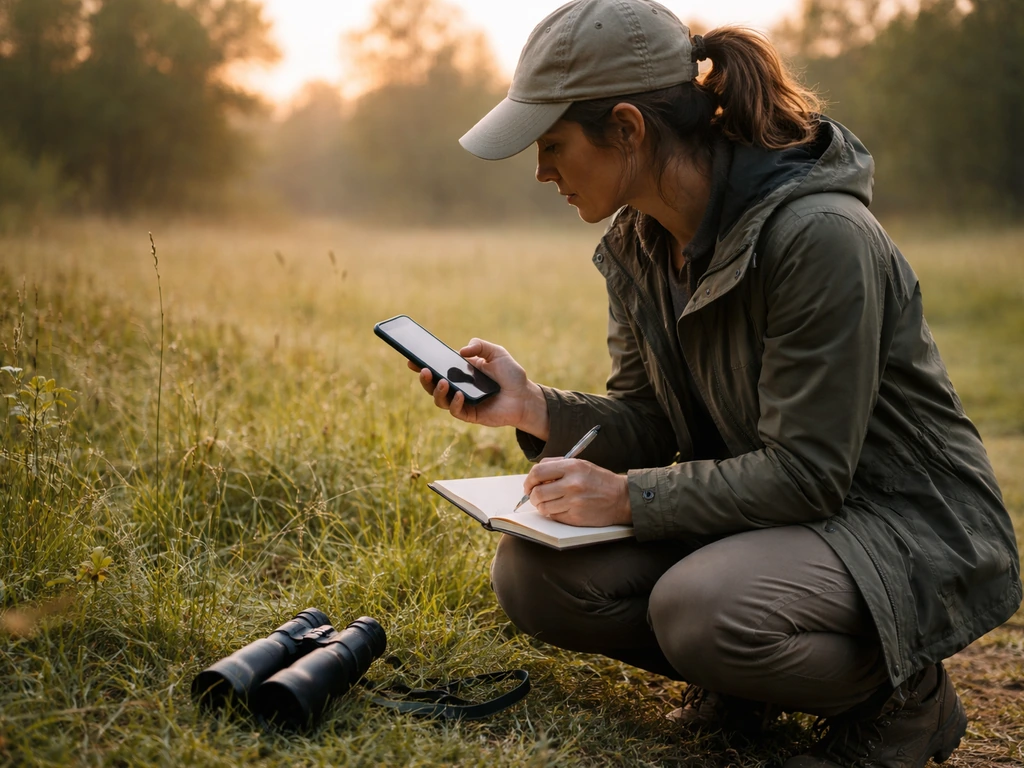
Mnemonic phrases are phonetic translations of a call into words you already know. All About Birds has a list of 30 of these for common species, and they work because they tie an abstract sound to something your brain can already picture. The Eastern Towhee says "drink-your-teeeea." The White-throated Sparrow sings "Old Sam Peabody Peabody Peabody." These aren't perfect phonetic matches, but they capture the rhythm and pitch shape well enough that your brain locks onto them. Audubon has confirmed this approach sticks better than description alone. Write your mnemonic down in a notebook alongside the species name so you can test yourself later without audio.
Chant the rhythm
If no existing mnemonic fits, make your own. Play the call, then out loud (yes, actually say it) chant or hum the rhythm back. Tap it on your knee. The goal is to encode not just the pitch but the temporal pattern, the spacing of notes, the number of repetitions, the rise or fall at the end. That rhythm is often more reliable for field ID than pitch anyway, since pitch can shift with distance.
Build sound categories
Group your target calls into rough sound categories: buzzy, whistled, raspy, repetitive, short chip, long warble. This gives you a mental filing system. When you hear something in the field, your brain can first ask "is this buzzy or whistled?" before drilling down to species. Think of it like sorting a deck of cards by suit before trying to find the specific card. This chunking approach dramatically reduces the cognitive load of recall in the field.
Practice routine: short daily sessions + spaced repetition

Cramming doesn't work for bird calls. Ten minutes every day beats one hour once a week, every time. The research on spaced repetition backs this up: spreading your practice over days and weeks with gaps in between produces far better long-term retention than massed sessions. Auditory perceptual learning, specifically, has been shown to improve even when the intervals between sessions range from minutes to weeks, so you don't need to be rigid about the schedule. Consistency matters more than precision.
Here's a simple weekly rhythm that actually works:
| Day | Session type | What to do |
|---|---|---|
| Day 1 | Intro listen | Play each target call 3 to 5 times. Say the mnemonic out loud after each listen. Write it in your notebook. |
| Day 2 | Active review | Play each call once. Before looking at the name, say what you think it is. Check yourself. |
| Day 3 | Rest or light field walk | No structured session. Just be alert outside and see if you catch any of your target calls naturally. |
| Day 4 | Cue-free recall test | Look at your notebook. For each mnemonic phrase, try to hear the call in your head before playing it. Then play and compare. |
| Day 5 | New examples | Find 2 to 3 different recordings of the same species (different individuals, different regions). Listen and see if the mnemonic still holds. |
| Day 6 | Mixed quiz | Shuffle your target calls and quiz yourself without labels. Score yourself honestly. |
| Day 7 | Add one new species | Only if you scored well on Day 6. Otherwise repeat the week with the same set. |
Cornell's Bird Song Hero is a free game that fits perfectly into the Day 2 and Day 6 slots. It gives you structured, game-like practice with immediate feedback, which keeps the sessions engaging without turning into a grind.
Training your ear for recall (tests without the recording)
Recognition (matching a sound you hear to a name) and recall (generating the sound mentally before you hear it) are different skills, and you need to train both. Most people only train recognition, which is why they freeze in the field when they hear something and can't place it.
To train recall, try these without any audio playing:
- Look at a species name in your notebook and try to mentally "hear" the call. What does it sound like? Is it buzzy or whistled? How many notes? What's the rhythm? Then play the actual call and see how close you were.
- Read your mnemonic phrase out loud and try to mimic the pitch and rhythm you remember. This feels silly but it works. The act of trying to retrieve the sound, even imperfectly, strengthens the memory trace far more than just listening again.
- Walk outside without headphones and actively listen. When you hear a sound, try to name it before reaching for your phone. Even if you're wrong, the effortful attempt is what builds the skill.
This approach is backed by what learning researchers call the testing effect: the act of trying to recall something (and struggling a little) improves retention better than studying the same material again. The key word is effortful. Easy recognition with the answer visible doesn't build the same neural pathway that genuine retrieval effort does.
Handle real-world variation (distance, time, similar species, regional differences)
One recording from one individual in one location is a starting point, not the whole picture. When you get into the field, you'll hear the same species sounding subtly different depending on distance, season, sex, and local dialect. Expecting your training recording to be a perfect template will throw you off.
Here's how to build tolerance for variation into your training:
- Train with multiple recordings of the same species. The Cornell Lab's Macaulay Library and the Cornell Guide to Bird Sounds (updated February 2026) are specifically curated to represent variation across individuals and regions. Use at least 3 to 4 different recordings per species before you consider yourself solid on a call.
- Learn the dawn chorus separately. Many species sing more actively and sometimes differently at dawn for territorial reasons. If you've only trained on midday recordings, dawn can sound like a different bird. Try listening to dawn recordings of your target species specifically.
- Account for distance. A call heard 50 meters away loses high-frequency detail and sounds softer and thinner. When practicing, try to find some recordings made at varying distances so your ear learns the "degraded" version, not just the studio-quality close-up.
- Know that females sometimes sing too. In some species the female sings a quieter or structurally different version of the song. Audubon notes this is more common than most beginners expect. If a call almost matches your template but feels off, it might be a female.
- Regional dialects are real. If you're birding in a new location, your home-trained template may not match the local population. Merlin Sound ID can help you narrow down what you're hearing, and you can then pull up the regional recordings on Macaulay Library to recalibrate.
Urban environments deserve a special mention. Reverberation and noise in cities can actually change the acoustic features of what reaches your ears, including lowering the apparent maximum frequency of a song. If you're birding in a city, don't be surprised when a call sounds muddier or lower-pitched than the recording. This isn't a new species. It's physics.
Next steps: tools, resources, and how to keep improving
Once you've built a solid foundation with your first 5 to 10 species, the system scales naturally. Keep adding one or two new species per week and cycling back to review older ones. Here are the tools worth having in your rotation:
- Merlin Sound ID (Cornell Lab, free): Use it in the field for feedback when you're uncertain. Don't use it as a crutch before you've tried to identify the call yourself. The workflow should be: hear it, try to name it, then check Merlin.
- Bird Song Hero (Cornell Bird Academy, free): A structured game-style trainer that builds recognition and gives immediate feedback. Great for daily 5 to 10 minute sessions.
- Macaulay Library (Cornell Lab, free): The world's largest natural sound archive, fully online. Use it to pull multiple recordings of your target species across regions and individuals.
- All About Birds mnemonics list: Start here for your first batch of phonetic transliterations before you develop your own.
- A simple notebook: Low-tech but genuinely useful. Write your mnemonics, notes on rhythm, and self-quiz scores. Being able to test yourself off the page without any audio is one of the most powerful tools you have.
If you want to go deeper into finding and organizing recordings to practice with, it's worth exploring how to search bird calls effectively, since sourcing the right material makes a big difference. If you want to go deeper into finding and organizing recordings to practice with, it's worth exploring how to search bird calls effectively, since sourcing the right material makes a big difference.
If you want to practice with the right recordings, learn how to search bird calls effectively so you can build a better training library. And if you want a broader framework for building your overall sound vocabulary, learning bird song as a structured skill, not just memorizing individual calls, is the natural next level.
The difference between someone who's good at identifying bird sounds and someone who's great at it usually comes down to how systematically they've built their ear over time, not raw talent.
Give yourself permission to be slow at the start. The first few species feel hard. By species 15 or 20, your ear has built a reference library and new calls start clicking into place much faster. That's not magic. That's just how perceptual learning works when you give it consistent, effortful practice over time.
FAQ
How many bird species should I add per week if I keep hearing the wrong one in the field?
Keep it to 1 to 2 new species per week, then force a 2 to 3 day review of the previous week’s set. If you’re repeatedly mixing two similar species, pause new additions and do 5 to 10 minutes of cue-free recall on just those two until your confusion rate drops.
What should I do when the field audio I hear doesn’t match my training recording (pitch, speed, or tone)?
Shift from “exact sound match” to “pattern match.” Focus your labeling on rhythm and call structure first (note count, pauses, rise or fall), then treat pitch changes as expected variation caused by distance, vegetation, and local acoustics.
Is it better to memorize songs by description (like “buzzy” or “raspy”) or by phonetic mnemonic?
Use both, but prioritize mnemonic or rhythm cues for recall. Descriptions help you categorize on first hearing, then the mnemonic lets you retrieve the exact species name without relying on the audio being present.
How can I tell whether I’m training recognition or actual recall?
Run quick recall checks: cover the app or stop playback, then say the species name before you press play again. If you can only identify it after hearing it, you are mostly doing recognition. If you can generate the sound in your head and name it first, you are training recall.
What’s the fastest way to fix confusion between two similar-sounding species?
Do a two-species “contrast drill.” Cycle through 10 to 20 short test attempts where you must choose between species A or B without listening first, then immediately listen and correct. Keep the drill small and repeat daily for a few days instead of expanding to more species.
Should I practice with calls at the same volume and playback speed as the field recordings?
Practicing at varied playback speeds and volumes improves tolerance. Try 0.75x to 1.25x speed and slightly different volumes for the same call, but keep the label and rhythm cue consistent so your memory doesn’t fragment into multiple versions.
Do I need long sessions to memorize bird calls effectively?
No. Short daily sessions work better than occasional long ones. A practical target is 10 to 15 minutes per day using one or two test modes (labeling with audio, then cue-free recall). If you skip days, restart with cue-free recall for the most recent species rather than jumping back into new ones.
How do I handle birds that have multiple call types (song, flight call, contact call) for the same species?
Treat each call type as a separate “item” in your training list, even if the species name is the same. Label them differently (for example, “contact chip” vs “dawn song”), then review them separately so you do not blend patterns that occur in different contexts.
What if I don’t find a matching mnemonic for a species, and my own cue sounds random?
Make the cue rhythmic and repeatable. A good test is whether you can chant or hum it with the correct timing after a day, even if the exact consonants are imperfect. If you cannot reproduce the rhythm, revise the cue until the spacing and ending are reliable.
How should I test myself if I live somewhere new or travel, where I hear unfamiliar dialects?
Before field time, select one “core” training recording per species, then add a second recording from a different region when possible. In your recall tests, aim to identify the call even if the timbre differs, because dialect and habitat variation is normal.
What is the best way to organize my practice recordings so I don’t waste time searching?
Create a folder structure by species and call type, and name files consistently with date, source, and call category. Then keep a separate “daily queue” list so each session starts with the same kind of active recall, not with re-deciding what to study.
Can I practice without an app or downloaded recordings?
Yes, using your own field recordings. Record short snippets during walks, then label them immediately while fresh in memory. On later days, practice cue-free recall first, then reveal the recording to correct, so the learning still includes effortful retrieval.
Next Article
How to Learn Bird Song: Step-by-Step Practice Routine
Step-by-step routine to learn bird song fast: pick species, decode phrases, practice daily, troubleshoot confusion, meas