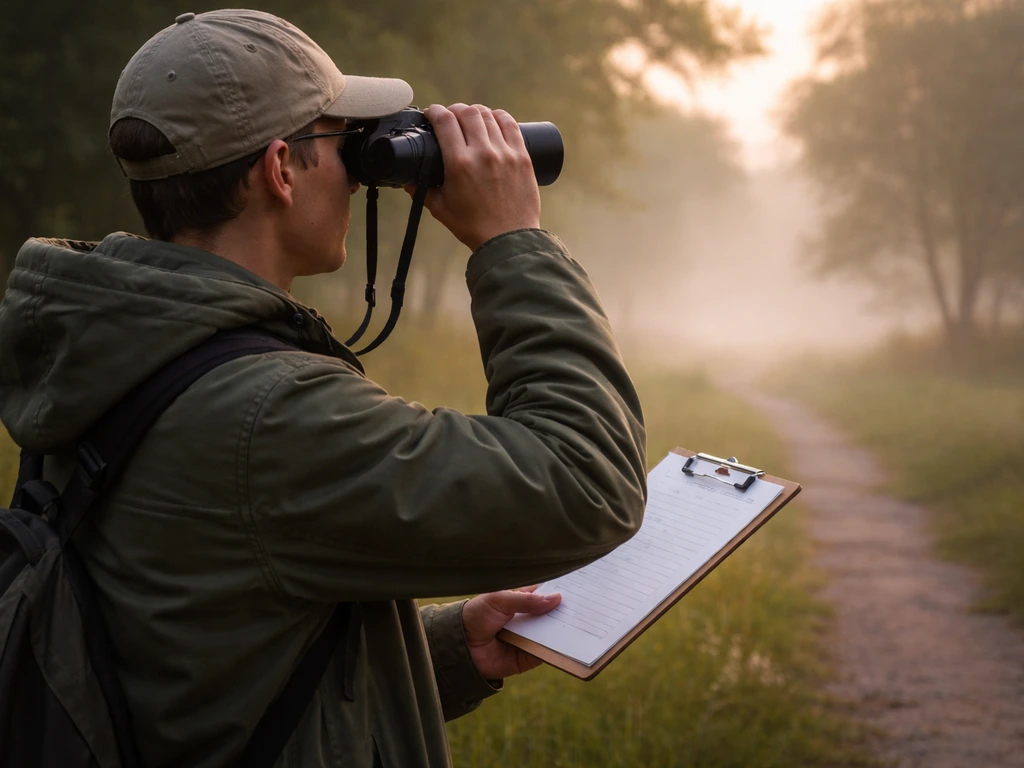
You can run your first bird survey today with a notebook, a pair of binoculars, and about two hours. Pick a spot, walk or stand still, write down every bird you see or hear, and submit your list to eBird when you get home. That's the core of it. Everything below is about doing it better: choosing the right method for your goal, keeping your data consistent, and making your records actually useful to science.
How to Conduct a Bird Survey: Beginner Field Guide

Marcus Hendricks
3 May 2026
Pick your survey goal and scope

Before you head outside, spend five minutes answering one question: what do you actually want to know? Your answer shapes everything from where you go to how long you stay. Vague goals produce vague data. Specific goals produce records that you, and others, can actually use.
Here are the most common goals for beginner surveyors, with plain-language descriptions of each:
- Species inventory: You want to know which birds use a particular place. Great for a backyard, a local park, or a patch you visit regularly. No need for complex methods.
- Abundance estimate: You want rough numbers, not just a species list. This means counting individuals systematically, not just noting presence.
- Breeding evidence: You want to know whether birds are nesting at a site. This requires multiple visits across the breeding season and attention to specific behaviors.
- Population monitoring over time: You want to track whether numbers go up or down from year to year. This demands the most consistency in method, route, timing, and effort.
If you're brand new, start with a species inventory at a single site. It's low pressure, genuinely useful, and gives you the reps you need to build toward more structured monitoring later. Once you've done a few, you'll naturally want to start counting individuals and tracking change, and at that point the more formal methods below will feel approachable rather than intimidating. Once you are comfortable with species inventories, you can expand your surveys into counting bird populations over time.
Scope also means deciding on your geographic boundary before you go. Are you surveying a specific field, a trail loop, or a grid square assigned to you by a bird atlas project? Write the boundary down. It sounds obvious, but knowing exactly where your survey starts and stops is what separates a casual walk from a reproducible scientific record.
Choose a survey method and design the route or points
There are two workhorses for bird surveys: point counts and transects. Both are used by major monitoring programs worldwide, and both are accessible to beginners with a bit of planning.
Point counts
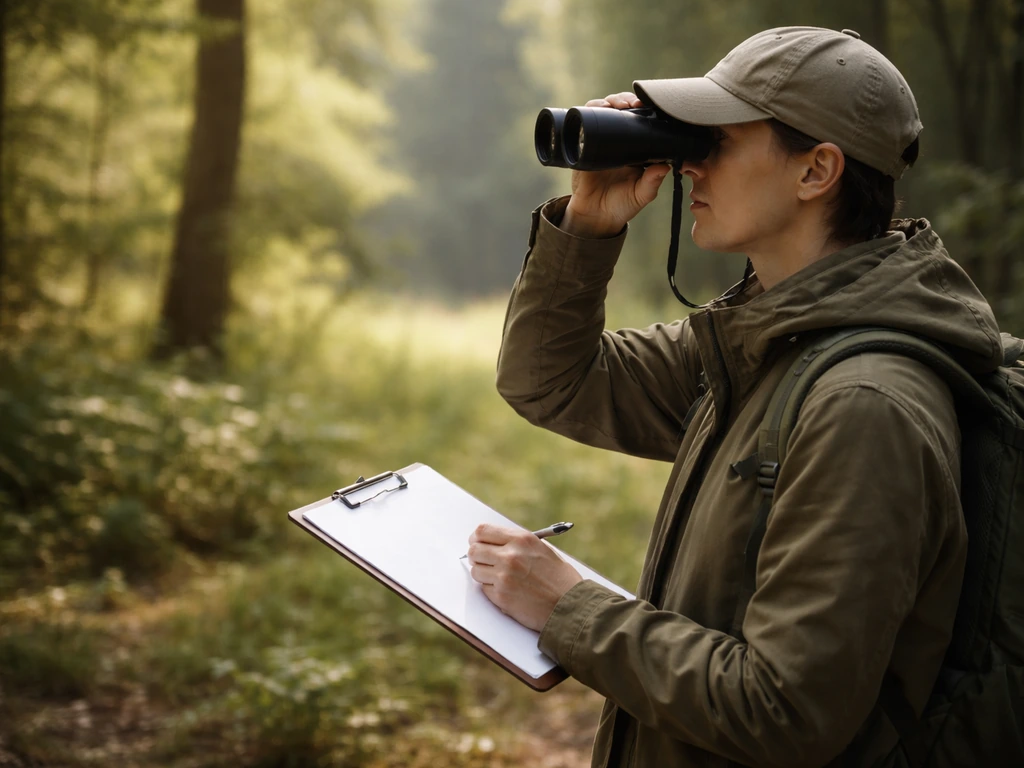
A point count means standing still at a fixed location for a set time and recording every bird you detect. The Bird Conservation Network recommends 10-minute counts with a defined radius, for example 100 meters for open habitats like prairies and grasslands, or 50 meters for denser habitats. The North American Breeding Bird Survey (BBS), the largest long-term monitoring program on the continent, uses 3-minute counts at each of 50 stops spaced roughly every 800 meters along a 24.5-mile route. For a beginner's first survey, one to five points with 5 to 10 minute counts each is plenty. Space your points far enough apart (at least 200 to 300 meters in open habitat) so you're not counting the same bird twice.
Point counts work especially well in habitat where visibility is limited, like forest, because you're relying heavily on sound. Standing still lets birds settle and sing more naturally than they would if you were moving through their territory.
Transects
A transect means walking a fixed route at a slow, steady pace and recording birds as you go. The BTO's British Breeding Bird Survey uses this format, asking observers to record all birds seen or heard along the route, divided into distance bands (for example, within 25 meters, 25 to 100 meters, and beyond 100 meters). The distance-band approach lets analysts later correct for the fact that you're much more likely to detect a bird close to you than one far away. For your first transect, a straight or simple loop route of 1 to 3 kilometers works well. Mark your start and end points on a map before you go.
eBird stationary counts and traveling counts
If you're submitting to eBird (and you should be), these protocols map neatly to eBird's built-in options. A point count becomes a Stationary Count: one location, fixed time, you don't move. eBird defines a Stationary Count as observations made over a known time period at a fixed point, and if you use the eBird Mobile app with location tracking enabled, it will automatically classify your checklist as Stationary if you stay put. A transect becomes a Traveling Count, where you log the distance traveled and the time. Both require you to record the start time, duration, and (for traveling counts) distance covered. These effort fields are what make your data comparable to other people's data.
Atlas surveys
If your region has an active Breeding Bird Atlas project, you may be assigned a specific grid block to survey. Atlas projects like those run through eBird use breeding-evidence categories: Observed, Possible, Probable, and Confirmed. Confirmed is the strongest level and requires directly observed breeding activity, like a bird carrying food to nestlings. Atlas surveys are not about counting individuals; they're about mapping where species breed. If you join one, focus on visiting your block during the breeding season (typically late April through July in North America) and noting the behaviors you see, not just the species.
What to bring and how to use your gear

You don't need expensive equipment to run a good survey. If you're interested in going beyond simple counts, you can also learn how to use a bird wattmeter to measure and interpret electrical signals safely gear. If you want more than counts and can handle the permits and ethics, you may eventually need to know how to weigh a bird for research or banding. Here's what actually matters, ranked by importance:
- Binoculars: 8x42 is the sweet spot for most habitats. Wide field of view, enough magnification to resolve field marks, and not so heavy that your arms give out after an hour. If you already own 10x42 or 7x35, use them. Don't buy new ones just for this.
- Something to record on: A waterproof field notebook and a pencil (not a pen, pencils work in the rain and cold) is the most reliable system. The eBird Mobile app is excellent and saves a transcription step later. I use both: a physical tally sheet in the field and eBird at home.
- A watch or phone: You need to track your start time and duration. eBird requires these for effort-based protocols.
- A field guide or Merlin: For North America, the Merlin Bird ID app from Cornell Lab is free and has a Sound ID feature that can suggest species from audio picked up by your phone's microphone. It's a brilliant training tool. Use it to confirm IDs, not as a replacement for learning calls yourself.
- Optional audio recorder: A small external microphone plugged into your phone dramatically improves recording quality over a built-in phone mic. If you record audio to support your IDs, keep the original files. eBird now (as of January 2026) automatically normalizes uploaded audio volume, but trimming your recordings to the key moment before upload still makes a big difference to reviewers.
- Weather-appropriate clothing and sun protection: Sounds basic, but I've cut more than one survey short because I underestimated how cold a 6 a.m. marsh feels in April.
One thing beginners often overlook: prepare your recording sheet before you go, not when you're standing in the field trying to remember what columns you need. At minimum, pre-write spaces for species name, count, detection type (seen, heard, or both), distance band if you're doing a transect, and any breeding behavior you observe. If you're doing atlas work, add a column for breeding code.
Fieldwork workflow: times, pace, recording, and identification
When to go
Bird activity peaks in the first two to three hours after sunrise. That's when singing is most intense, movement is highest, and detectability is at its best. For a breeding season survey, aim to start within 30 minutes of local sunrise. The BBS, for instance, specifies an official route-specific start time tied to local sunrise. For a casual inventory or your first attempt, any calm morning works. Avoid going out in heavy rain, strong wind (above about 15 mph), or dense fog. Birds go quiet in those conditions and you'll record a fraction of what's actually there, which skews your data.
Weather conditions aren't just a comfort issue: they're a data quality issue. If you're doing repeated surveys at the same site, always record the weather at the start of each session. Wind speed, precipitation (none, light, heavy), and sky cover are the key fields. The BBS requires observers to log start weather as part of the official data capture. Even if you're just submitting to eBird, noting conditions in the comments helps anyone who later reviews your data.
Pace and attention
Walk slowly. Slower than you think you need to. On a transect, a pace of about 1 kilometer per 30 to 45 minutes is appropriate in most habitats. Stop frequently, look and listen, then move on. At point count stations, don't start counting the moment you arrive; give the birds 30 to 60 seconds to settle after your approach before you begin your timed count.
The hardest skill to build early on is avoiding double-counting. A bird that flies ahead of you on a transect is tempting to count again when you reach where it landed. The BTO's guidance is clear: record a bird in the section and distance band where you first detect it, and don't re-record it if it moves. If you're genuinely unsure whether you're seeing the same individual again, don't count it twice. Undercounting is better than overcounting for data integrity.
Recording sightings and hearings
Record every bird you can identify with confidence, whether you see it or only hear it. eBird's best practices are explicit: if you only report birds you saw and missed birds you heard, mark your checklist as incomplete. A complete checklist means you recorded every species you could identify by sight and by sound. Incomplete checklists are still useful but can't be used for absence analysis, which is one of the most powerful things researchers do with survey data.
For counts, eBird recommends reporting the highest number of individuals you observed at one time during the survey period. So if you see 12 American Robins at once early in your walk and only 4 later, report 12, not 16. This avoids inflating numbers by counting birds that moved through your view multiple times.
The BTO offers a useful optional practice: note the detection type for each record. Circle birds detected visually, underline birds detected by sound, and use a different mark for birds detected both ways. This matters more than it sounds. Research has found that combining detection types without tracking them separately can bias density estimates, because singing birds are far more detectable than silent ones. You don't have to do this on a casual survey, but it's a great habit to build.
Identifying birds in the field

You will not be able to identify everything you hear. That's normal. Even experienced birders leave some birds as "unidentified warbler" or "small brown job." Here's a practical approach to handling uncertainty:
- Note what you can: size, shape, plumage, behavior, habitat, and any sounds. Write these down immediately, not after the survey.
- Use Merlin Sound ID in real time if you're unsure of a call, but always try to confirm the ID visually before you commit it to your list. Merlin is a suggestion engine, not an oracle.
- If you can't confidently ID a bird, record it at the highest level you're sure of. "Accipiter sp." is better than a wrong species name. eBird accepts these slash and spuh entries.
- For unusual or unexpected species, write a description in your notes: size relative to a known species, the exact call or song phrase, behavior, and habitat. eBird reviewers look for exactly this kind of detail when assessing rare or surprising reports.
- Don't guess. A wrong confident ID adds noise to a dataset. An honest uncertain ID adds nothing harmful.
Data quality: avoiding bias and handling uncertainty
The biggest threats to survey data quality are inconsistent effort, detection bias, and wishful thinking on IDs. Here's how to keep each in check.
Consistent effort
Every time you deviate from your planned method, you introduce noise. If you do 10-minute counts one visit and 5-minute counts the next, you'll detect more species on the 10-minute visits purely because you had more time, not because more birds were there. Fix your time windows, your route, your start time, and your distance radius before your first survey and stick to them. This is especially critical if you're planning to do the same survey across multiple seasons or years.
Detection bias
You will always detect more birds when they're singing than when they're silent. You'll detect more birds in open habitat than in dense scrub. You'll detect more on calm mornings than on windy ones. None of this makes your data wrong; it just means you need to be aware of it. Comparing surveys done in similar conditions at the same time of year is much more meaningful than comparing a bluebird morning in May to a blustery afternoon in August. When in doubt, note the conditions and let the reader of your data account for it.
Handling unusual sightings
If you see something genuinely surprising, your first instinct might be excitement, which is great. Your second instinct should be skepticism. eBird has a data quality review system where reviewers assess submitted checklists, and rare or unexpected species trigger a flag. When this happens, a reviewer will contact you and ask for supporting evidence. Don't take this personally; it's the system working correctly. Support your claim with detailed written notes, a photo if you got one, or an audio recording. eBird is clear that duplicated or unsupported records can be marked as not public. Being thorough from the start saves everyone time.
Ethical considerations in the field
A survey is meant to observe birds, not disturb them. Watch for stress cues: alarm calls, freezing, crouching, and adults repeatedly flushing from an area can all indicate you're too close, especially near active nests. The Migratory Bird Treaty Act makes it illegal to disturb a migratory bird's nest without a permit, and that applies to well-meaning surveyors just as much as anyone else. If you locate a nest, note its presence from a distance and move on. eBird has a Sensitive Species feature that reduces public display of exact nest locations for vulnerable species, and using it is the right call when you find something that could attract unwanted attention.
Finish strong: compile results and share or submit records
Getting your data out of your notebook and into a format others can use is where a lot of beginner surveyors drop the ball. Here's a simple end-of-survey workflow that takes less than 20 minutes if you do it while the survey is still fresh.
- Transcribe your tally sheet while you remember the context. If you used a paper field sheet, enter the data into eBird (or your preferred database) the same day. Memory fades fast.
- Create a complete checklist. In eBird, this means marking the checklist as complete if you actively recorded every species you could identify. Include your start time, duration, distance traveled (for a transect), and number of observers.
- Add breeding codes if applicable. If you're doing atlas work or simply observed breeding behaviors, use eBird's "Add breeding code" option for each species where relevant. Common codes include singing male (S), carrying nest material (CN), and distraction display (DD). These codes feed directly into atlas and monitoring databases.
- Upload any supporting media. If you recorded audio or photos, attach them to the relevant species on your checklist. Trim audio clips to the relevant section before uploading. As of January 2026, eBird automatically normalizes audio volume after upload, but a clean, trimmed file is still far easier for reviewers to assess.
- Write notes for unusual species. For anything flagged by eBird's filters, or anything you weren't 100% certain about, add a written description in the species comments. Include size, plumage details, behavior, habitat, and how long you observed it.
- Summarize your results for yourself. Even a simple list of total species, most abundant species, and any highlights is worth writing up. It builds your own personal dataset over time and helps you track what's changing at your sites.
- Share with local groups. Regional bird clubs, state ornithological societies, and local conservation organizations often welcome survey data, especially from sites not regularly covered. An eBird checklist is already shareable; you can also export your data from eBird in multiple formats for submission to other databases or for your own analysis.
If you have a large backlog of historical records from past walks, eBird's spreadsheet import tool lets you group observations by date, location, time, and protocol to create batches of checklists at once. For very old records where effort details are incomplete, use the Historical protocol in eBird and fill in as much effort information as you can.
A quick reference: what makes a survey record genuinely useful
| Element | Why it matters | Minimum to record |
|---|---|---|
| Start time | Bird activity varies with time of day; comparisons need to be like-for-like | Hour and minute |
| Duration | Longer surveys detect more species; effort data corrects for this | Total minutes on site |
| Location | Exact coordinates or named site; needed for mapping | GPS point or named site with coordinates |
| Distance traveled | For transects; enables density calculations | Kilometers walked |
| Weather | Wind, rain, and cloud affect detectability | Wind level, precipitation, sky cover |
| Species list | The core of the survey | All species identified with confidence |
| Count per species | Needed for abundance analysis | Highest count of each species at one time |
| Detection type | Seen, heard, or both; important for bias correction | At least note if heard-only |
| Breeding codes | Required for atlas work; useful for any breeding-season survey | Behavior observed, if any |
| Notes on unusuals | Supports data quality review | Written description for anything unexpected |
Bird surveys connect directly to topics like doing a structured bird count or tracking population changes over time, and the method you choose for your first survey often leads naturally into those more specific approaches. The fundamentals here, consistent effort, honest recording, and prompt submission, apply equally whether you're tallying birds in a backyard or contributing to a multi-year population monitoring project. Get one survey done, submit it, and you'll have a much clearer sense of where to go next.
FAQ
How many bird surveys do I need before my results are meaningful?
For beginners, pick one protocol and keep it simple. Do a single-site species inventory first, then move to repeated visits (same time of day, same duration, same boundaries). If you want population trends, you need multiple surveys across weeks or months, not just one outing.
What should I do if I run out of time and cannot complete the full count?
If you cannot keep the exact duration, make the deviation explicit in your checklist notes (for example, ended early due to noise or safety). Do not silently switch between 5-minute and 10-minute counts, because effort differences can look like real bird changes.
How do I prevent double-counting when a bird moves ahead of me during a transect?
Avoid double-counting by using your first detection rule. If you detect a bird in a specific point or transect segment, you record it there, and you do not add it again later even if it moves into the next segment. If you truly cannot tell whether it is the same individual, it is safer to leave it out than inflate the count.
Can I include birds I only hear, and how should I record them if I am not sure of the species?
If a bird was heard but not seen, you can still include it, but mark the detection type (heard only). If you cannot confidently identify the species from sound, record it as unknown (for example, “unidentified warbler”) rather than guessing, since wishful IDs create false positives.
Which method should I use in forested habitat, point counts or transects?
If you need to choose between point counts and transects, use point counts when visibility is limited (forests, dense vegetation) because sound carryover matters and you stay put longer. Use transects in open habitat where you can scan more effectively and keep a consistent walking pace.
What if I have to stop often or change pace on a transect?
For a traveling route, keep a steady pace and record distance and time consistently. If you take detours or stop for long periods, you should end the checklist and start a new one, so the data reflect the protocol you actually followed.
How consistent do my start times need to be if I plan to compare visits?
Track your start time carefully, and for repeated surveys keep the timing consistent relative to sunrise (for example, always starting 20 to 30 minutes after sunrise). Bird activity shifts through the morning, so two surveys at different times can be hard to compare even on the same day.
Should I cancel a survey if the weather turns bad?
Dress and plan for calm conditions. If heavy rain, strong wind, or dense fog reduces detection, you should postpone if your goal is comparability across dates, since you will detect fewer birds and that can be mistaken for population change.
How do I keep transect distance bands reliable if I do not walk at exactly the same speed each time?
For transect distance-bands, pace guides are the priority. Mark start and end points on a map, then use your planned walking time to ensure you cover the route at a consistent speed. Do not “make up” for slow walking by compressing bands, because that breaks the distance-band assumptions.
If I join a breeding bird atlas, should I still count individuals?
If your goal is “where species breed,” do not treat atlas work like a count. Record breeding evidence behaviors (like carrying food to young or repeated visits) and visit during the breeding window for your region, then use the assigned breeding categories rather than estimating abundance.
What happens if I submit a surprising or rare bird record to eBird?
eBird’s data quality reviewers may ask for verification if something is rare or unexpected. Have supporting notes ready, ideally including where, when, and what you observed (and whether it was seen, heard, or both). Photos and audio help, but detailed written evidence often resolves questions.
What should I do if I discover a nest or other sensitive wildlife location during my survey?
If you find something sensitive, use your platform’s sensitive-species controls so exact locations are not displayed publicly. Note the information for your own records, but restrict public detail to protect vulnerable species and reduce disturbance risk.
How should I report numbers if I see the same species multiple times during the survey?
In general, use the highest count you observed at one time during the survey period, not a sum across multiple moments. If you are uncertain whether birds are the same or different individuals, keep it conservative and avoid combining counts from separate intervals.
What is the practical difference between a complete and incomplete checklist?
If you use an incomplete checklist, you should expect it to be less useful for absence-style questions. A complete checklist means you recorded every species you could identify by both sight and sound during the survey window, so commit to staying within your planned method rather than “only listing your favorites.”
Next Article
How to Do a Bird Count: Step-by-Step for Accurate Results
Step-by-step guide to how to do a bird count, choose methods, avoid double-counting, log sightings, and submit data.