You can learn to imitate the songs of a Greenfinch and a Linnet as a beginner by breaking each bird's sound into small, repeatable vocal units, practicing them with proper breath support, and using recordings to check your accuracy. Neither song is technically demanding, but both have a couple of signature sounds that take time to nail: the Greenfinch's drawn-out wheeze and the Linnet's rapid rattling phrase. Start by knowing exactly which bird you're imitating, then drill those key sounds one at a time. If you want, you can adapt the same step-by-step vocal imitation approach for learning how to play Little Bird, using recordings and short practice bursts.
How to Sing Greenfinch and Linnet Birds: Beginner Guide

Marcus Hendricks
17 May 2026
First, make sure you know which bird you're actually imitating
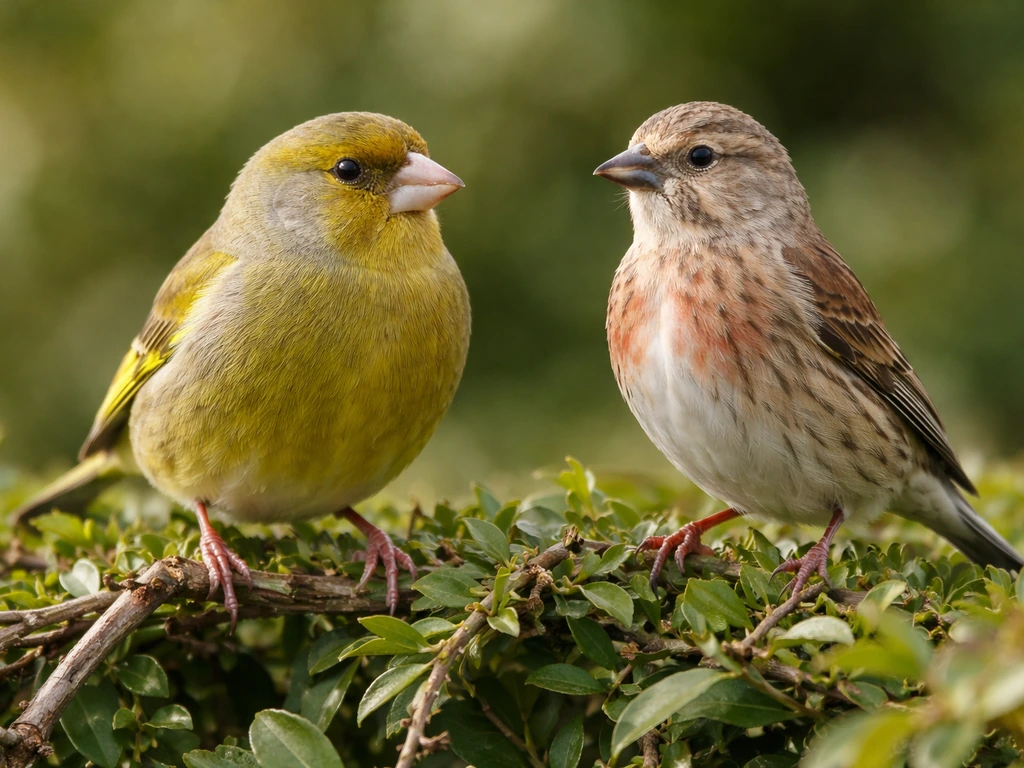
Greenfinch and Linnet get mixed up all the time. Both are small British finches, both hang around farmland and garden hedges, and both have that general 'cheerful finch chatter' quality that makes beginners lump them together. But their songs are genuinely different, and practicing the wrong one is a frustrating waste of time.
The Greenfinch (Chloris chloris) is a chunky, yellow-green finch with a heavy bill. Its signature is a slow, drawn-out wheeze that sounds like a long, slightly buzzy exhale. That wheeze is the thing that separates it from almost every other garden finch. If you don't hear the wheeze, you're not listening to a Greenfinch song.
The Linnet (Linaria cannabina) is slimmer and browner, with a red forehead on the breeding male. Its song is faster and more rattling, built out of short syllables strung together in a pleasant, rapid warble. Think of it as more energetic and less 'wheezy' than the Greenfinch. Linnets often sing in flight or from a high perch, which gives the song a slightly airy, open quality.
Before you practice a single note, go to a reliable audio source (the RSPB website or the Merlin app from Cornell Lab both have excellent recordings) and listen to each bird at least five times in a row. Do this with headphones. You want to lock in the difference before you open your mouth.
What each song actually sounds like: notes, rhythm, and key phrases
Greenfinch song breakdown
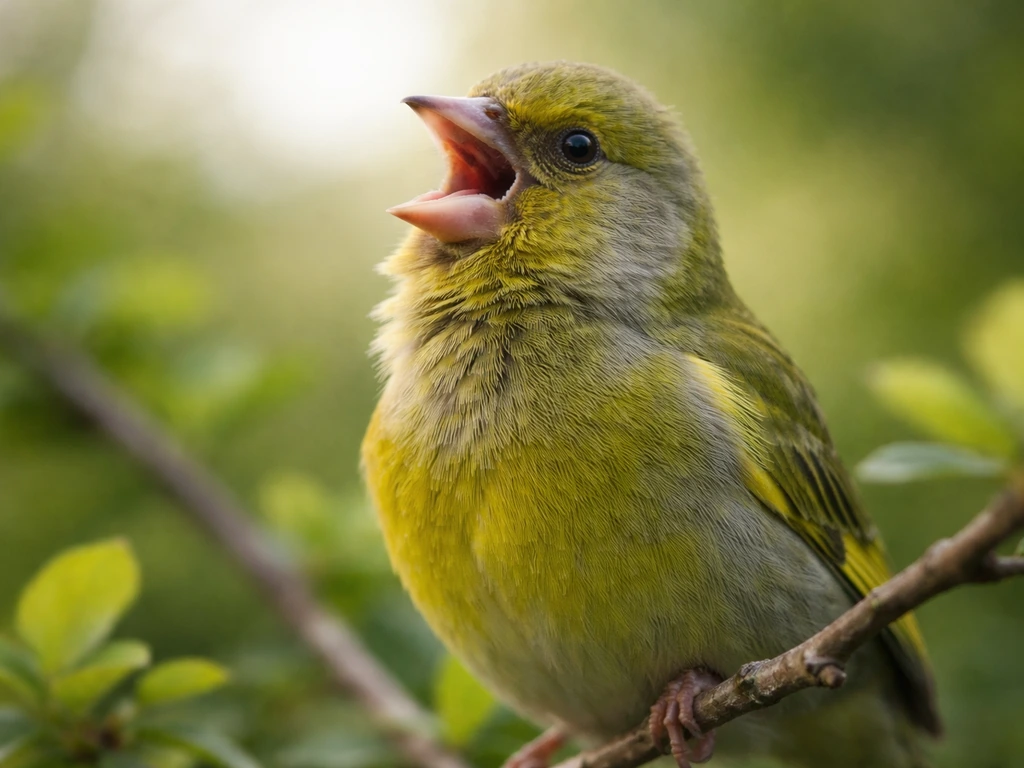
The Greenfinch song is described by the RSPB as a quiet, rambling warble that stitches together short but varied phrases. There's no single repeated note: it mixes bright little trills, quick chirpy runs, and then that long wheeze. Think of it as three layers you need to learn separately.
- The wheeze: a drawn-out, buzzy monosyllable often written as 'dzeeeeuuu' (Sussex Wildlife Trust) or simply a long, slow exhale with slight pitch. This is the most recognizable element. It sits low-ish in pitch and has a slightly rough, almost nasal texture.
- Short bright phrases: rapid syllable clusters like 'chu chu chu' or 'wup wup wup' (RSPB). These are quick, clean, and higher in pitch than the wheeze. They come in bursts of 3 to 5 syllables.
- The 'djuwee' contact note: a two-syllable sound where the second half flicks upward in pitch. It sounds a bit like a question — 'dee-WEE?' It often appears between phrase bursts.
- Simple call: 'pew pew' (RSPB). This one is easy to learn first and useful as a warm-up before tackling the full song.
Linnet song breakdown
The Linnet song is faster and more consistently twittery. GWCT gives a useful syllable cue: 'Tett-ett-ett,' a short rattling sequence that captures the rapid, bouncing rhythm. Birdfact describes the full song as a pleasant, rapid warbling with trilling notes, which is a good mental picture.
- Rattling core phrase: 'Tett-ett-ett' or similar rapid consonant-heavy clusters. The key is speed and a slightly nasal bounce. It shouldn't sound smooth or flute-like.
- Call type (bouncing twitter): often written as 'twittwitt' or 'tit-it-it' (Birdfact). These are very quick, light, and percussive. Think of fast finger-tapping on a table.
- Breeding-season 'tetter-tett': a slightly different rattling phrase heard near the nest. It's denser and shorter than the full song.
- Overall texture: the Linnet warble is generally 'clear' to slightly nasal in quality, not buzzy like the Greenfinch. All About Birds uses terms like 'buzzy,' 'clear,' and 'trilled' to describe bird-sound quality, and the Linnet sits firmly in the 'clear/trilled' category while the Greenfinch's wheeze is solidly 'buzzy.'
Step-by-step vocal imitation practice
Here's where the actual work happens. I'd strongly recommend doing this in short sessions of 10 to 15 minutes, twice a day, rather than one long session. Your voice gets fatigued faster than you expect when you're doing unfamiliar sounds.
Step 1: Warm up your voice first (always)

This sounds fussy but it matters. NIDCD guidance on voice care specifically says to support your voice with deep breaths from the chest and avoid relying on the throat alone, because throat-only use leads to strain. Before any bird-sound practice, do 60 seconds of lip trills (buzzing your lips together while breathing out, like a motorboat sound). This is a recognized warm-up used in voice therapy that reduces tension in the vocal folds and builds breath control. It also happens to get you ready for the Greenfinch's buzzy wheeze specifically.
Step 2: Nail the Greenfinch wheeze first
This is the hardest sound in the Greenfinch repertoire, so tackle it early in each session when your voice is fresh. The 'dzeeeeuuu' sound requires you to do three things at once: breathe out slowly and steadily, keep your lips slightly parted with a relaxed jaw, and add just a touch of vocal buzzing rather than a clean sung note. It shouldn't sound like singing a vowel. It should sound more like a very slow, drawn-out sigh with a slight vibration.
- Take a slow, full breath from your abdomen, not your chest alone.
- Open your mouth slightly, relax your jaw, and let your lips sit loosely.
- Start the exhale with a soft 'dz' consonant (like the middle of 'adze') to create the buzzy onset.
- Let the sound drift gently downward in pitch as you exhale, finishing with a slight 'oo' vowel shape.
- Keep it quiet. The RSPB describes Greenfinch song as quiet. Loudness kills the texture of this sound.
- Repeat 5 times in a row, then pause and listen to a recording to re-calibrate.
Step 3: Practice the Greenfinch 'djuwee' and short phrases
The 'djuwee' note is easier than the wheeze because it's shorter. Say 'djuh-WEE' and make sure the second syllable flicks up in pitch quickly, like you're asking a quick question. Practice that upward flick until it feels natural. For the short phrase clusters ('chu chu chu'), keep them light and rapid, almost as if you're gently blowing air through each syllable rather than pushing hard with your voice.
Step 4: Build the Linnet rattle
The Linnet's 'Tett-ett-ett' rattle is all about speed and a slightly nasal vowel. Say 'teh' rapidly three or four times, making sure the 't' at the start of each syllable is crisp and the vowel is short. The nasal bounce comes from letting some airflow go through your nose slightly as you produce the 'eh' vowel. Don't overdo this or it'll sound forced. The rhythm should be fast and even, like a light drumroll. Once you can do a clean 'tett-ett-ett,' practice following it immediately with a 'tit-it-it' burst, which mirrors what the bird does in its warbling sequences.
Step 5: String the elements together
Once you can produce each unit separately, practice stitching them together loosely. If you also want to use this same birdsong focus in music, start by learning how to play the bird opening and match the rhythm to the phrases you hear. For the Greenfinch, try: a short 'wup wup wup' burst, then a pause, then the long wheeze, then a 'djuwee.' For the Linnet, try: a 'tett-ett-ett' rattle, a short pause, then 'tit-it-it,' then another rattle. Keep the combinations varied rather than rigid: the real birds don't follow a strict script.
Ear training: record yourself and compare

Recording yourself is the single most important tool here. You can't hear your own voice the same way a listener (or a bird) hears it. Use your phone's voice memo app. Record 30 seconds of your best attempt, then immediately play back the bird recording and your recording in alternation. Listen for three things specifically: pitch accuracy, rhythm accuracy, and texture (buzzy vs. clear).
For a deeper check, use the Merlin app from Cornell Lab. Merlin has a built-in Sound ID feature that shows a spectrogram as it listens. A spectrogram plots frequency (pitch) on the y-axis against time on the x-axis, so you can literally see the shape of your sounds compared to the bird's sounds. All About Birds recommends playing audio while watching the spectrogram scroll so you can align repeated events and compare sections. Record yourself doing the Greenfinch wheeze, then play the recording in Merlin and watch the spectrogram: the wheeze should show as a long, slightly thick descending line. If it looks too thin (too clean/pure), you need more buzz. If it's too short, you're cutting the exhale too early.
Merlin's best-practice guidance from eBird suggests recording continuously for at least 30 seconds to get a useful sample. Apply the same rule to your own practice recordings: record at least 30 seconds of practice so you have enough material to compare across multiple attempts. After each session, pick the one element you got closest to correctly and celebrate it. Noticing small wins keeps the practice sustainable.
EarBirding's framework for categorizing bird sounds by repetition and speed is also useful here: the Linnet's rattle is what EarBirding would call a 'series' (same syllable type repeated at speed), while the Greenfinch warble is more of a 'warble' (varied syllable types in sequence). Training your ear to hear those structural categories, not just the notes themselves, speeds up the learning process significantly.
Common mistakes and how to fix them fast
| Mistake | Why it happens | Quick fix |
|---|---|---|
| Greenfinch wheeze sounds like a sung note (too clean/pure) | Using too much vocal cord tension, aiming for a 'singing' tone | Relax the jaw completely, reduce volume, add a soft 'dz' onset to create buzz |
| Pitch drifts upward during the wheeze | Running out of breath support midway through | Start from a fuller breath; the wheeze should drift slightly downward, not upward |
| Linnet rattle is too slow | Overenunciating each syllable | Drop the vowel almost entirely, focus on the 't' consonants, and think 'tapping' not 'speaking' |
| Linnet sounds too smooth or flute-like | Singing with full voice rather than a lighter, nasal bounce | Let a small amount of air come through the nose on the vowel; keep overall volume low |
| Greenfinch 'djuwee' flick doesn't land | The upward pitch movement is too gradual | Make the pitch jump sharp and sudden, like a quick question inflection in spoken speech |
| Both sounds come out too loud | Natural singing instinct is to project | Both birds sing at close range and softly; actively dial down volume by half or more |
| Running out of breath mid-phrase | Shallow chest breathing | Practice slow abdominal breathing first; all exhales should come from the belly, not the shoulders |
Your practice plan: what to do daily and weekly
Consistency beats intensity here. Ten focused minutes twice a day will get you further than an hour once a week. Here's a realistic structure for your first four weeks.
Week 1: ear training and individual sounds
- Listen to Greenfinch and Linnet recordings back-to-back twice per day. Just listen, no imitation yet.
- On day 3, start practicing only the Greenfinch 'pew pew' call and the Linnet 'tett-ett-ett' rattle. Two elements, that's it.
- Record yourself each day and compare to the original recording.
- By end of week 1, you should be able to produce a recognizable (even if rough) version of both of those basic elements.
Week 2: tackle the Greenfinch wheeze
- Add the 'dzeeeeuuu' wheeze to your daily practice. Spend 5 minutes per session on this one element.
- Use the spectrogram check in Merlin or a free spectrogram app at least once this week to visually verify your wheeze shape.
- Continue the Linnet rattle daily. Add the 'tit-it-it' call variant.
- Benchmark: by end of week 2, the wheeze should have a rough buzz quality even if pitch isn't perfect yet.
Week 3: add context and variation
- Practice the 'djuwee' upward flick for the Greenfinch.
- Start stringing Greenfinch elements together: short phrase, pause, wheeze, djuwee.
- Practice the Linnet's faster warbling run: tett-ett-ett, tit-it-it, tett-ett-ett in sequence.
- Record a 30-second imitation attempt for each bird and compare to reference recordings in full.
Week 4: self-assessment and refinement
- Play your week 4 recordings against your week 1 recordings. The improvement is usually more obvious than you expect.
- Focus your remaining practice on whichever element still sounds furthest from the original.
- Try using the Merlin Sound ID to see if your Greenfinch wheeze gets even close to triggering a Greenfinch suggestion (it almost certainly won't, but checking the spectrogram shape is useful feedback).
- Benchmark: by end of week 4, you should be able to produce both birds' core sounds with recognizable rhythm and approximate pitch, and a distinct difference in texture between the two.
Being honest about what you're doing and where to go next
Here's the honest part: human vocal imitation of bird song is always approximate. You can get genuinely close on certain elements, especially simple calls like the Greenfinch 'pew pew' or the Linnet rattle, but you won't fool a Greenfinch. If you mean playing the Greenfinch song on a wire, start by matching its slow drawn-out wheeze sound first. The real value of this practice is building your ear. Once you've spent a week trying to produce a Greenfinch wheeze, you will never mishear one again. That ear training payoff is the real prize.
Avoid telling people you 'can do the Greenfinch' in a way that implies you could use it to attract birds or that it's acoustically accurate. It's a skill for your own enjoyment, for teaching others what a sound roughly resembles, and for deepening your engagement with birdsong. That is a genuinely useful thing. It just has limits.
The best next step after this kind of vocal mimicry work is structured bird-sound learning using tools like Merlin's Sound ID or Cornell's All About Birds resources. how to play bird song. If you want to go beyond imitating calls, you can also explore how to play fly like a bird by practicing rhythmic, breath-led movement patterns. To get the most accurate results, practice color-specific song cues in the Bird Sort Color style using those same identification tools. If you're using these skills for bird bingo, practice by identifying the specific calls on your bingo card and marking them off as you hear them bird-sound learning. Both give you a framework for identifying and categorizing bird sounds systematically, which makes your ear far sharper than mimicry practice alone. If you've enjoyed getting to know these two finches, exploring similar guides on how to play bird song or how to listen to and learn other bird calls is a natural next step that builds on exactly the same ear-training muscles you've been developing here.
Stay hydrated during practice sessions, warm up before every session with lip trills, and stop if your throat feels sore. These sounds should be produced quietly and with relaxed muscles. If it hurts, you're pushing too hard. Keep it gentle, keep it fun, and your ear (and voice) will get there faster than you think.
FAQ
Can I practice without headphones, or do I really need them for how to sing green finch and linnet bird songs?
Yes, but only as a safety check. Use headphones when comparing, keep the volume low enough that you can still breathe comfortably, and record yourself from the same distance each time. If the reference audio is too loud, you may unconsciously copy its texture instead of the bird’s rhythm.
What should I do if my Greenfinch wheeze comes out as a normal sung note (not buzzy)?
If your Greenfinch “wheeze” sounds like a clear vowel note, you are probably shaping too much pitch instead of adding controlled buzz and a slow exhale. Try extending the exhale while keeping your jaw relaxed and lips slightly parted, then add only a small amount of vibration, not a full sung tone.
How do I fix a Linnet rattle that turns into a slow, mushy “tuh-tuh-tuh” sound?
Let your “tett-ett-ett” stay crisp and short, and keep the rhythm even. If it turns into something slow or bubbly, it often means the vowel is too long or the syllables are not separated sharply. Think “fast drumroll,” with the initial t kept clean on every repeat.
Should I practice the Greenfinch and Linnet as separate sessions, or mix them together from day one?
Do a quick swap in your routine. For one session, focus on just the wheeze or just the rattle for 10 minutes, then stitch for the remaining time. Beginners usually improve faster when one signature element is perfected before combining multiple units.
Do I need to match pitch exactly right away, or can I build up from texture and rhythm?
Don’t chase perfect accuracy in pitch during early attempts. Aim for the correct texture first (buzzy for the wheeze, rattled and rapid for the Linnet), then refine pitch and timing after each recording review. The spectrogram comparison works best once you can produce the basic shape reliably.
Why does the “same” bird song sound different each time I practice, and I keep getting confused?
You’re likely hearing different variants, or you may be matching the wrong bird’s signature. Return to the initial discrimination step: listen at least five times to the target recording you’re imitating, then drill only the signature sound (Greenfinch wheeze, Linnet “tett-ett-ett”).
How should I record in a way that makes comparisons actually useful (phone settings, length, consistency)?
Yes, but only within limits. Use your voice memo to record at least 30 seconds continuously, and keep the mic position consistent. For spectrogram checks in Merlin, watch for how long the wheeze event lasts and whether the rattle appears as repeated rapid events, not one smeared blur.
Is it normal for my throat to get tired when learning how to sing these bird songs, and when should I stop?
If your throat starts to feel tight or sore, stop and switch to non-vocal drills like more lip trills with gentler volume, or take a full rest. Birdsong imitation should be produced with relaxed effort and breath support, not strained pushing.
Do I need to reproduce the bird’s full song as an exact script, or can I improvise slightly?
Not completely, because the birds also use natural timing variations and changing dynamics. A practical approach is to keep your “units” consistent, then allow flexible gaps and vary the order slightly during practice. Recording and spectrogram review can confirm you still match the key events even with a looser sequence.
What if my comfortable singing range doesn’t match the recording pitch for the Greenfinch or Linnet?
For singing low or high, prioritize breath flow and clarity of the signature sound. If you strain to reach a pitch, your texture will suffer (the Greenfinch wheeze may become too clean, and the Linnet rattle may lose crisp t’s). Choose a comfortable pitch range, then map the rhythm and texture within that range.
Next Article
How to Play Bird Song: Recordings, Calls, and Imitation
Play bird songs from recordings, bird-call devices, or your voice, plus ethical playback tips and quick practice routine