If you found a feather and want to know what bird it came from, you can actually get pretty far with just your eyes and a bit of method. You probably won't always nail the exact species, but you can usually narrow it down to a group, a size class, or at least a likely type of bird. That's a genuinely useful result, and it's more than most people expect when they pick one up off the ground. Here's how to do it properly, step by step.
How to Identify Bird Feathers Step by Step Guide

Marcus Hendricks
4 Apr 2026
Start with what you can actually see
Before you look anything up, spend two minutes just observing the feather itself. This sounds obvious, but most people skip straight to googling and end up chasing the wrong rabbit. What you notice in these first two minutes will shape every comparison you make afterward.
Size
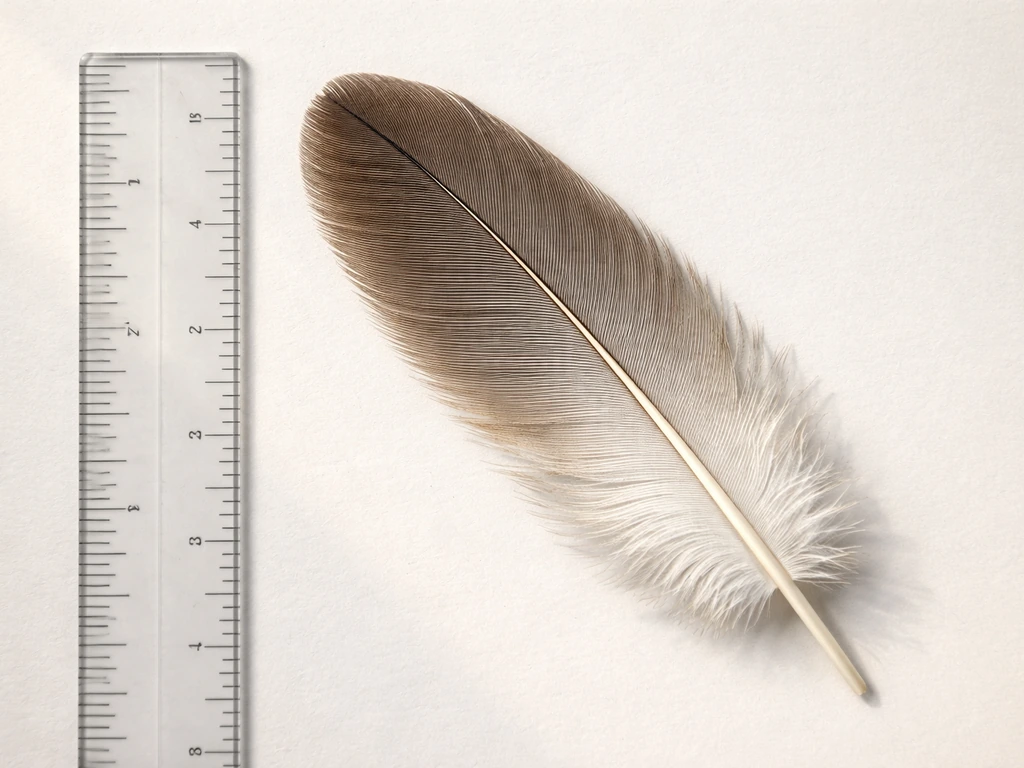
Measure it. Seriously, grab a ruler. A 2-centimeter fluffy body feather points you toward small songbirds. A 40-centimeter stiff primary feather points you toward large raptors or waterfowl. Size is one of the fastest filters you have, and it costs you nothing.
Color and pattern
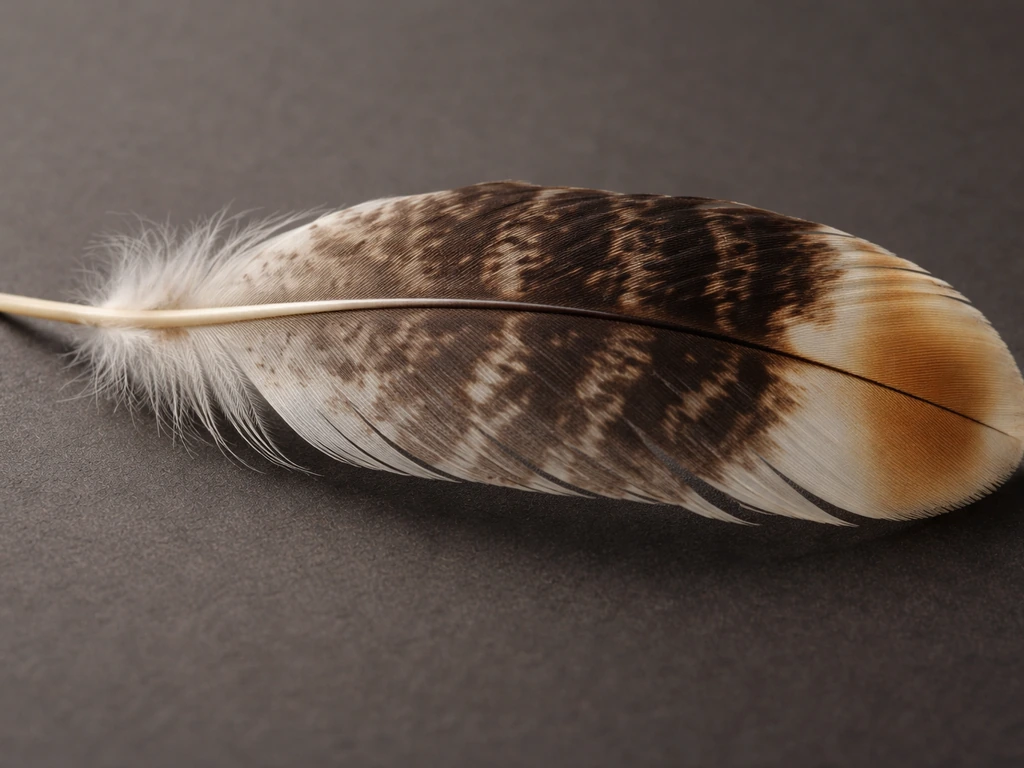
Look at both sides of the feather. The upperside (dorsal) and underside (ventral) are often different, and both matter. Note base color, tip color, and any banding, spotting, streaking, or iridescence. Iridescence is a big clue because it only comes from structural coloration in the feather, not pigment, and it shifts with the light angle. Hold the feather up to different light sources to see if it flashes. Also check whether color fades from the base to the tip, which can indicate directional bleaching from sun exposure.
Wear and condition
A worn, ragged feather tells a different story than a fresh one. Tips that are frayed or missing barbs usually mean the bird was well into its annual molt cycle before this feather dropped. Very rounded, pale-edged tips are often signs of juvenile plumage. Heavily worn tail feathers can look dramatically different from fresh ones of the same species, which is one of the sneaky reasons misidentifications happen. If the feather looks bleached along the edges and darker toward the base, that's weathering, not the bird's natural pattern.
Feather anatomy: what the parts actually tell you
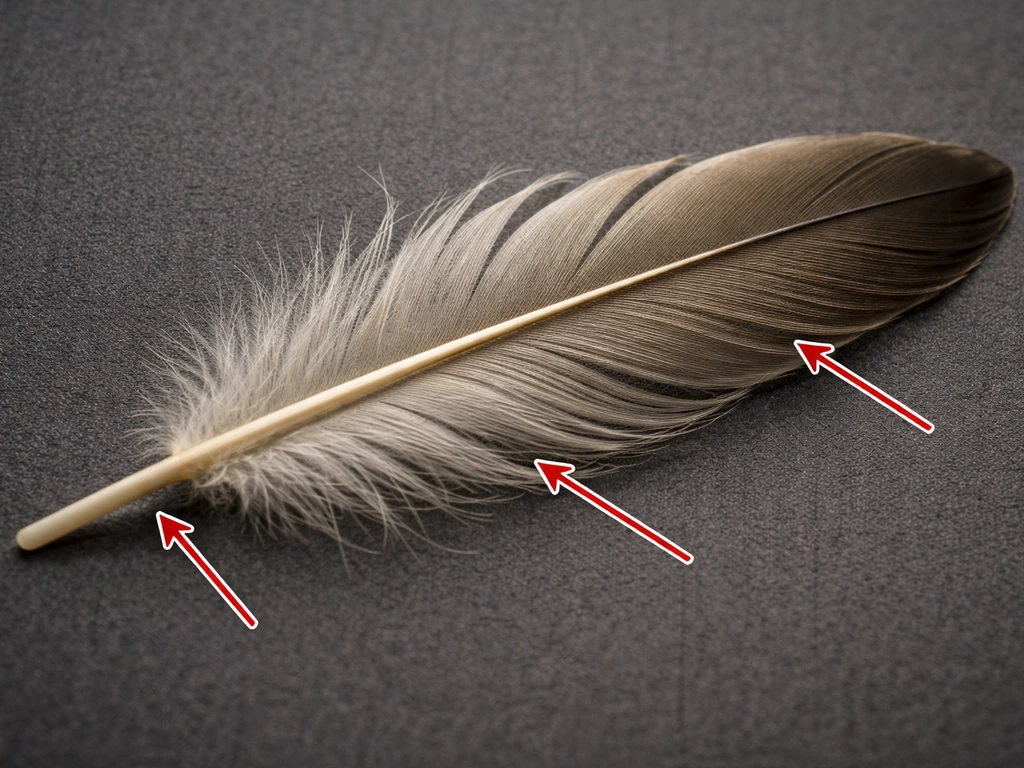
You don't need a biology degree to use feather structure as a clue, but knowing three basic parts makes everything else click faster.
- Calamus (the quill): the hollow, cylindrical base that was embedded in the bird's skin. A long calamus relative to the total feather length suggests a flight or tail feather. A very short calamus is typical of body contour feathers.
- Rachis (the shaft): the central spine that runs up from the calamus and supports the vane. Stiff, thick rachises belong to feathers that do aerodynamic work, like primaries and tail feathers. Thin, flexible rachises belong to body or down-type feathers.
- Barbs and barbules: the branches that fan off the rachis are called barbs. Each barb has tinier branches called barbules. In flight and contour feathers, the barbules have microscopic hooks that zip the vane together into a smooth, rigid surface. In down feathers, those hooks are absent or minimal, so the vane stays fluffy and open.
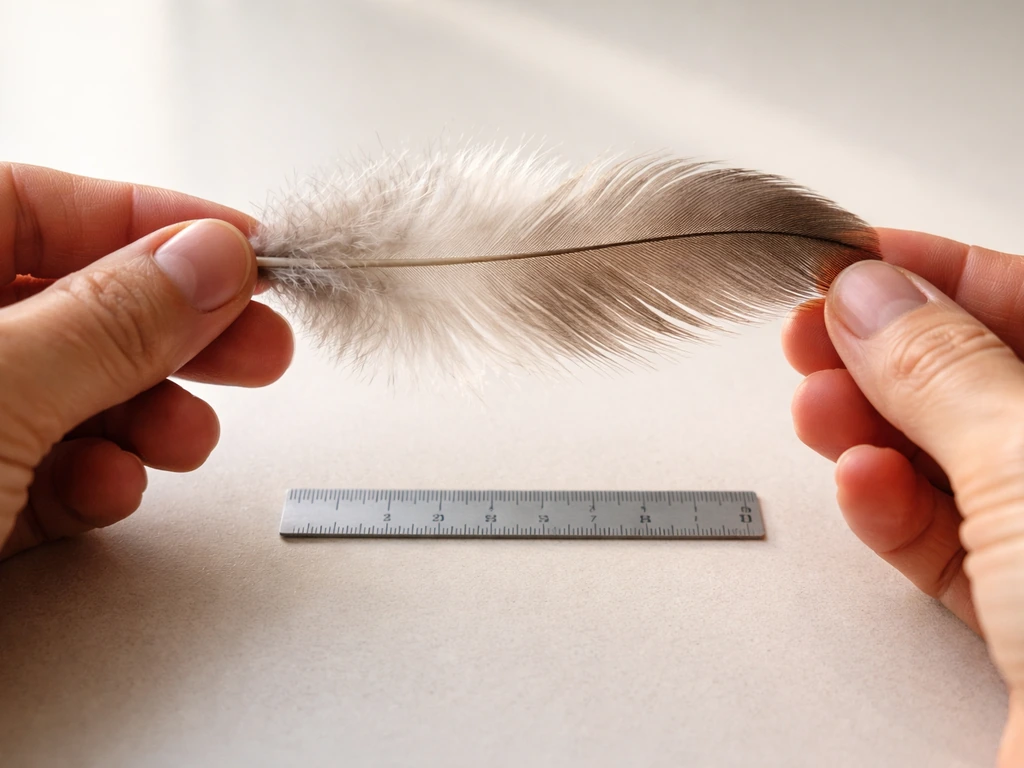
Here's why this matters for ID: if you run your fingers along the vane and the barbs zip back together after you separate them, you have a pennaceous (structured) feather, likely a flight, tail, or contour feather. If the barbs don't zip and just stay fluffed, you have a down or semiplume feather, which is a body insulation feather. That single test cuts your comparison list roughly in half.
The shape of the vane also tells you where on the bird the feather came from. Asymmetric vanes, where one side is noticeably narrower than the other, are characteristic of primary flight feathers. The asymmetry is an aerodynamic adaptation and is most dramatic in fast-flying birds. Symmetric vanes suggest secondaries, tail feathers, or body feathers.
How to figure out the bird from the feather (and what you can't conclude)
Here's the honest version: a single feather will rarely give you a locked-in species ID unless you're working with something visually distinctive, like a wild turkey tail feather or a blue jay primary. What it will do is give you a reasonable shortlist. Forensic ornithology labs, which use feather evidence in wildlife crime cases, regularly acknowledge that some feathers cannot be uniquely identified to species without additional molecular testing. So if you're getting a confident shortlist rather than a single definitive answer, you're doing this correctly.
Start with geography and habitat. A feather found near a salt marsh points you toward shorebirds, herons, and waterfowl. A feather from your backyard bird bath has a much smaller candidate pool than one found on a forest trail. Location narrows the list dramatically before you even open a field guide.
Then think about feather type and body position. A long, stiff, asymmetric feather is a primary. A shorter, stiffer, symmetric feather could be a secondary or a rectrix (tail feather). A smaller, rounder feather with a short calamus is a body contour feather. Rump and flank feathers are often highly colored in males during breeding season. Knowing where on the bird a feather probably came from helps you match it against the right part of a reference image.
Finally, combine size, shape, color, and location into a single filter. For example: large + asymmetric vane + brown with fine dark barring + found near woodland edge = reasonable candidate pool of raptors (Red-tailed Hawk, Cooper's Hawk, Barred Owl). That's still multiple species, but it's a useful starting point.
A step-by-step workflow for identifying what you found
Before diving into the steps, one practical note: in the United States, it's actually illegal to possess feathers from most native bird species without the proper permits, as noted by the U. The Feather Atlas notes that possession of feathers and other parts of native North American birds without a permit is prohibited by the Migratory Bird Treaty Act illegal to possess feathers from most native bird species without the proper permits. S. Fish and Wildlife Service. That doesn't mean you can't pick one up to look at it, but it's worth knowing if you plan to keep a collection. With that said, here's how to run through an identification properly.
- Handle carefully before anything else. Lay the feather on a clean, flat surface. Don't grab it by the tip or press the barbs flat. If it's fresh and intact, you want to keep it that way. Think of it the way museum handlers do: support the specimen, don't pinch or compress it.
- Photograph it from multiple angles. Take a photo against a plain white background, then against a dark background. Photograph both sides. Include a ruler or a coin for scale in at least one shot. Good photos are your insurance if the feather deteriorates or you want to ask experts later.
- Record where and when you found it. Note the habitat type, the date, your geographic location (county and state at minimum), and whether you saw any birds nearby. This context is often more useful than you'd expect.
- Measure it and assess the type. Use a ruler to get total length, vane width, and calamus length. Run the zip test on the barbs. Note whether the vane is symmetric or asymmetric. This tells you the feather type and probable body position.
- Make a shortlist of local birds in the right size range. Field guides organized by size make this easy. If you're looking at a 30cm primary from a forested area in the eastern US, you can eliminate most songbirds instantly and focus on raptors, corvids, and large waterfowl.
- Compare your feather to reference images. The USFWS Feather Atlas is specifically built for this: it covers 438 North American bird species and has an 'Identify My Feather' tool that lets you filter by pattern, color, and other traits to find matching flight feathers. Featherbase is another solid option that includes age- and sex-specific feather comparisons and measurement statistics. Cross-reference at least two sources before committing to a shortlist.
- Document your conclusion with appropriate confidence. Write down your top two or three candidates and why. Note what's consistent and what's uncertain. 'Likely Red-tailed Hawk primary based on size, barring, and habitat, but could be Cooper's Hawk' is a better result than a false single-species declaration.
If you're building a habit of collecting and examining feathers, it's worth reading up on how to collect bird feathers properly, especially for keeping specimens in good condition over time.
Look-alike feathers and where people go wrong
This is the section I wish someone had shown me earlier, because these pitfalls are common and genuinely confusing.
Tail feathers vs. body feathers from the same bird
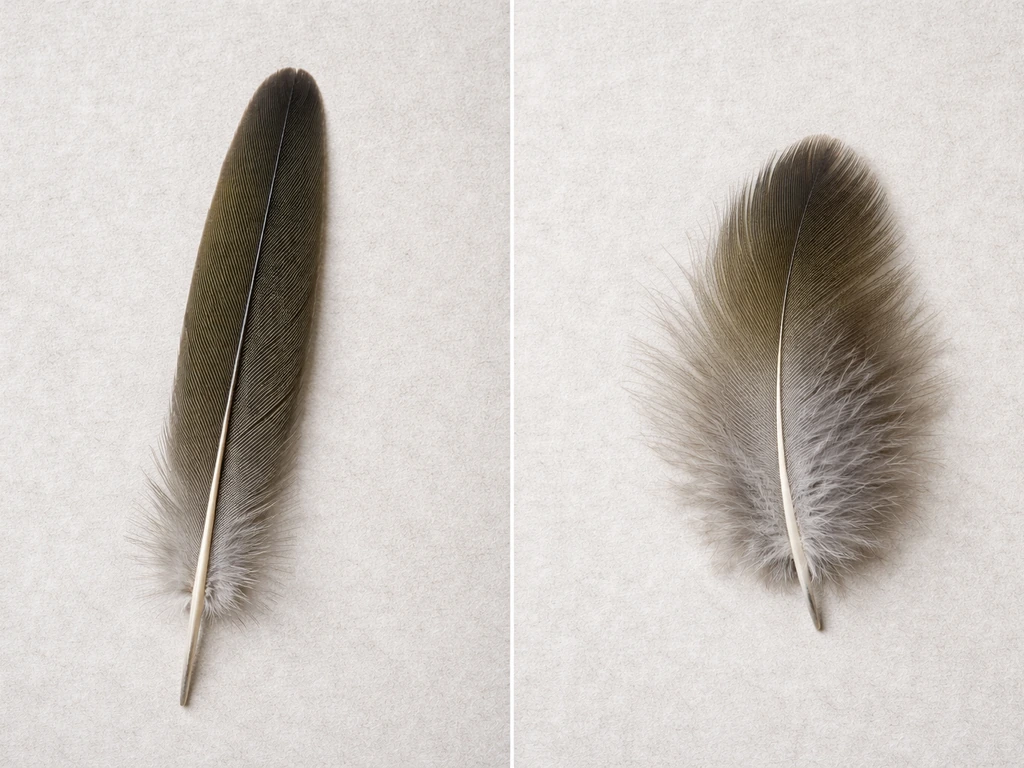
A tail feather and a body contour feather from the same bird can look like they belong to two different species. Tail feathers (rectrices) are stiff, symmetric, and often strongly patterned. Body feathers from the same bird are softer, rounder, and often a completely different color or pattern. This trips up a lot of beginners who compare a body feather to a tail-feather reference photo and conclude they don't match.
Shared colors across unrelated species
Brown with dark barring is one of the most common feather patterns on Earth and appears in everything from sparrows to owls to juvenile herons. If your only clue is 'brown with bars,' you need size and feather type to narrow it down. Don't lean on color alone.
Juvenile and molting plumage
Young birds often have completely different feather patterns than adults of the same species. A juvenile Red-tailed Hawk lacks the classic brick-red tail entirely. Molting birds can be carrying a mix of old and new feathers at the same time, and a dropped molt feather from an intermediate stage can look unlike any photo in a standard field guide. If the feather looks slightly 'off' for your best guess, juvenile or molt plumage is a likely reason.
Directional bleaching and fading
Feathers exposed to sunlight fade from the tips inward. A feather that was originally dark-tipped can end up looking pale-tipped after a season of wear. This is especially common in flight feathers that catch the most UV exposure. Always check the base color as the more reliable indicator of the original pigmentation pattern.
Primary vs. secondary flight feathers
Primaries and secondaries from the same wing can look quite similar in color but differ in shape. Primaries are longer, more tapered, and more asymmetric. Secondaries are broader, more rounded at the tip, and more symmetric. If you're trying to match to a reference and the shape feels slightly wrong, check whether you're comparing a primary against a secondary photo.
Tools and references that actually help
You don't need to buy anything to identify feathers effectively. Here's what I reach for, in order of usefulness.
| Tool or Resource | What It's Good For | Best Used When |
|---|---|---|
| USFWS Feather Atlas | Flight feather ID for 438 North American species; filterable by pattern/color/type | You have a flight feather and want a visual match with official reference scans |
| Featherbase | Species comparison by measurement and age/sex characteristics; broad international coverage | You want to cross-check measurements or compare male vs. female feather differences |
| iNaturalist / Found Feathers project | Community ID review; post photos and get feedback from experienced naturalists | You're stuck and want human eyes on your feather photos |
| Cornell Lab Merlin / All About Birds | Regional species lists, plumage photos by age and sex; range maps | You need to know which birds are realistic candidates for your location |
| Field guide (regional print or app) | Quick visual reference organized by size and habitat | First-pass shortlisting before diving into databases |
The Found Feathers project on iNaturalist is particularly helpful when you're genuinely stuck. It's a citizen-science initiative built around community feather identification, and uploading a well-documented photo there often gets you feedback from people who've handled thousands of feathers. An iNaturalist community forum discussion also suggests adding feather observations to the “Found Feathers” project to get identification help from the community blank" rel="noopener noreferrer">community feather identification. Knowing how to find bird feathers in the first place, especially in habitats where specific species congregate, also gives you a head start on narrowing the candidate pool before you even start comparing.
If you want to go deeper into community photo sharing, Cornell Lab's tools allow you to submit bird photos via the Macaulay Library and eBird checklists, which is especially useful if you photographed a bird alongside the feather find and want to connect the two data points for a stronger ID.
What to do when you only have one feather and you're still stuck
Sometimes a single feather just isn't enough for a confident ID, and that's genuinely okay. Here's what to do in that situation rather than forcing a guess:
- Post your documented photos (with ruler for scale, both sides, multiple light angles) to the Found Feathers iNaturalist project or a birding forum and describe exactly where you found it.
- Use the USFWS Feather Atlas 'Identify My Feather' search tool and screenshot your top three matches to compare side by side rather than committing to one.
- Contact a local natural history museum, birding club, or university ornithology department. Many are happy to look at a photo and give an informed opinion.
- Accept a group-level ID if a species-level one isn't available. 'Large Buteo hawk, probably Red-tailed' is a legitimate and useful conclusion.
- Never discard your documentation. Even if you can't ID it now, good photos and location notes may help you later when you have more context or experience.
If your curiosity extends beyond identification to understanding how feathers come off the bird in the first place, the mechanics of how to pluck a bird are genuinely interesting from an anatomical standpoint and connect directly to how feathers are structured at the follicle. And if you're working with feathers more intentionally, the specific technique behind how to pluck bird feathers cleanly matters both for specimen integrity and for keeping the calamus intact, which (as you now know) is a key ID feature.
The bottom line is that feather identification rewards patience and documentation more than encyclopedic knowledge. You don't need to know every bird to make a good identification. You need to observe carefully, measure, compare methodically, and be honest about your confidence level. Do those four things and you'll get a useful answer from almost any feather you find. You can also use the Feather Atlas “Identify My Feather” tool to match feathers by observable traits Identify Feather Tool.
FAQ
What should I do if the feather is too small or broken to measure accurately?
Use the calamus length and the vane shape instead of overall size. Even when tips are damaged, the calamus can tell you whether you are likely dealing with a flight or body feather, and vane symmetry helps separate secondaries or rectrices from contour feathers.
How can I tell whether a feather came from a bird or from a man-made object (like a costume or pillow)?
Check for natural feather structure, especially a pennaceous feather’s barbs that align in a vane. Costume or synthetic fibers usually look uniform under close inspection, lack a true calamus, and do not show the same barb spacing or consistent asymmetry seen in real flight feathers.
Is iridescence always a sign of structural color, or can pigments cause a similar effect?
Most strong “flash” iridescence is structural, but lighting can exaggerate pigment shine. To reduce false positives, test under the same angle repeatedly, then compare both sides of the vane. Structural effects often change color dramatically with angle, while pigment-based colors typically shift less.
What’s the easiest way to distinguish a primary from a secondary if I only have one wing feather?
Focus on shape and taper. Primaries are usually longer and more tapered with more obvious asymmetry, secondaries tend to be broader and more rounded at the tip, and they often look more symmetric when you view the feather tip-on.
If I find feathers at different locations, can I assume they came from the same bird species?
Not reliably. Feather shedding varies by season, and many species share broadly similar brown or barred patterns. Combine location with feather type and wear condition, and if you are comparing multiple finds, track measurements the same way (length, vane width, and calamus length).
How does molt timing affect identification when I see mixed patterns on the same feather find?
Molt can create feathers at different stages, so one bird may drop look-alike but not photo-matching feathers. A practical approach is to flag “molt-suspect” feathers when the tips look unusually mixed (some fresher, some weathered) and then rely more on structural traits and feather type than on exact color pattern.
What if the feather looks bleached, but I suspect it might be a juvenile bird?
Use the base color as your anchor. Bleaching usually fades from the tips inward, while juvenile patterning is often a consistent whole-feather look. If the base still shows the expected adult patterning, treat it as weathering; if the base pattern itself differs, juvenile or species-specific plumage is more likely.
How much does feather wear change the shape compared to fresh feathers?
Wear can blunt tips and make the vane look less crisp, especially on tail feathers and flight feathers. However, it usually does not erase core geometry, like whether the vane is symmetric or asymmetric. If measurements are distorted, re-check symmetry and stiffness before you re-assign feather type.
Can two feathers from the same bird be different colors even if they look related?
Yes. Tail feathers, wing coverts, and body contours can have different base colors and patterns even on the same individual. That is why comparing a body feather to a tail-feather reference photo is a common mistake, and why matching feather type and body location matters.
Should I rely on color names from field guides (like “brick red”) when my feather is weathered?
Try not to. Field-guide color descriptions assume relatively fresh plumage under good light. Instead, compare pattern elements you can still see at the base (banding density, presence of barring, and overall saturation) and treat the exact hue as lower confidence.
Is it acceptable to use community ID sites even if I cannot provide the exact feather type?
Yes, but improve the odds by uploading multiple photos: top and underside, the tip, and a view showing stiffness and calamus. If you can, include approximate length and where you found it (region and habitat). Without that, “brown barred” feathers often get overly broad matches.
If I want a higher confidence ID, what should I collect or record besides the feather itself?
Record the feather’s measurements, feather type guess (down versus pennaceous, and asymmetry versus symmetry), and condition notes (frayed tips, bleaching gradient, missing barbs). Also note date and habitat, because that additional context narrows candidates more than color alone.
What are the most common safety or legal issues when handling native bird feathers?
Even if feathers are shed and not taken from a live bird, possession of feathers from many native species can be regulated depending on location and species. If you plan to keep a collection or trade specimens, verify local rules and avoid keeping feathers you cannot legally document.
Next Article
How to Bird Mouth a Rafter: Step-by-Step DIY Guide
Step-by-step guide to cut the bird-mouth notch in a roof rafter, measure pitch accurately, and fit for a tight seat.